How Can Businesses Benefit From Direct Answers Even Without Clicks?
TL;DR:
'A click tells you someone visited. A direct answer tells the market who the authority is. Those are two very different business outcomes and only one of them requires a click.' Most businesses evaluate search performance through traffic. If a page does not drive clicks, it is considered underperforming. This logic misses one of the most significant commercial advantages direct answers provide: business value delivered entirely without a visit to the website. Understanding how that value works, and how to leverage it deliberately, is what separates brands that treat direct answers as a traffic tool from those that treat them as a market positioning tool.
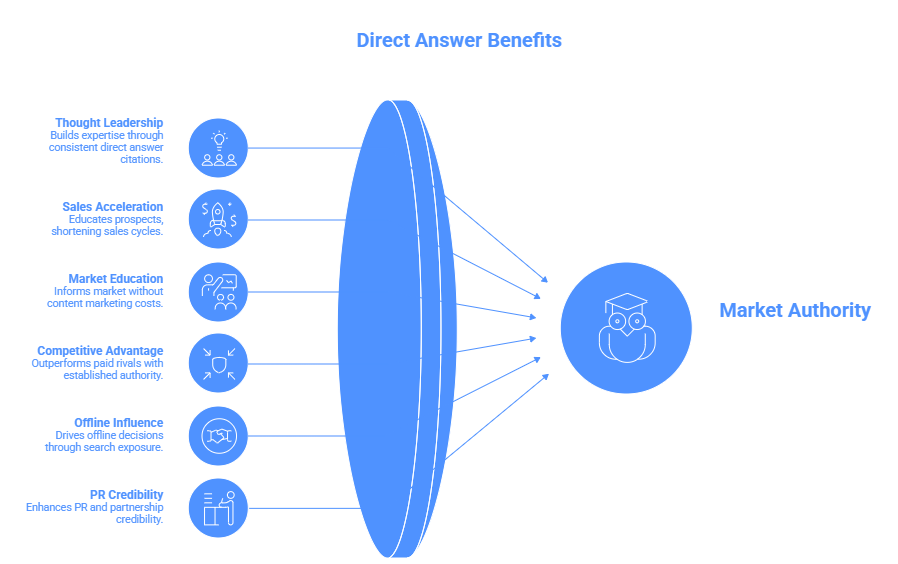
1. Thought Leadership Positioning at Scale
When a business is consistently cited as the direct answer source across multiple questions in its industry, Google is performing a public act of third-party endorsement at scale. Every user who asks a relevant question in that space sees the business named as the most authoritative answer — not through advertising, not through its own marketing claims, but through the search engine's selection process.
This repeated attribution builds thought leadership positioning that would cost significantly more to establish through paid media or content marketing alone. The business does not need the user to click, read a full article, or follow a social account to benefit. Each direct answer appearance deposits a thought leadership impression with every user who sees it — the cumulative effect of which is a market perception that the business defines the standards of knowledge in its category.
For B2B businesses in particular, where purchase decisions are shaped heavily by perceived expertise and industry credibility, this positioning has direct commercial weight. A procurement team researching a topic area and repeatedly encountering one vendor's content as the direct answer arrives at that vendor's sales conversation with a pre-formed trust disposition that no amount of outbound selling can replicate.
2. Sales Cycle Acceleration Through Pre-Educated Prospects
One of the most concrete and measurable business benefits of direct answer visibility without clicks is its effect on the sales conversation. Prospects who have encountered a business's content as a direct answer multiple times during their research phase arrive at the first sales interaction already educated on the business's perspective, already familiar with its terminology, and already holding a positive association with its name.
Sales teams at businesses with strong direct answer presence consistently report shorter discovery phases, fewer objection cycles based on basic category education, and higher initial trust levels from new prospects. The direct answers have done the educational work before the prospect ever made contact. The sales conversation can begin at a more advanced stage — evaluating fit and addressing specific needs — rather than establishing foundational credibility from scratch.
This acceleration has measurable commercial impact. A shorter sales cycle means lower cost of acquisition, faster revenue recognition, and a higher proportion of sales team time spent on qualified pipeline rather than early-stage education. The direct answer positions that produced this acceleration generated no click and no measurable session, but their commercial contribution to the sales outcome is real and significant.
3. Market Education Without Content Marketing Investment
Every business operating in a complex or emerging category faces the challenge of educating the market — explaining what the product does, why the problem it solves matters, and how to think about the category. Traditionally, this requires sustained investment in content production, distribution, and promotion.
Direct answers offload a portion of this market education cost to Google's infrastructure. When a business's explanation of a concept, a process, or a category appears as the direct answer to the questions the market is already asking, Google distributes that education to every user who asks. The business does not pay for distribution. It does not need the user to visit the website for the education to occur. The direct answer delivers the business's perspective on how to understand the problem it solves to the exact audience that is actively seeking that understanding.
For early-stage businesses introducing a new category, and for established businesses defending their framing of an existing one, this is a substantial and ongoing benefit. The direct answer functions as always-on market education, reaching audiences that would never have found the business through conventional search traffic and shaping how they think about the category before they begin evaluating solutions.
4. Strengthened Competitive Position Against Paid Rivals
Competitors who invest in paid search advertising — bidding on category keywords, competitor brand terms, and industry queries — rely on the assumption that users approaching those queries are undecided and open to influence. A business whose content already appears as the direct answer for those queries has already answered the user's question before the paid advertisement has an opportunity to create an impression.
The user who received the direct answer from one business and then sees a paid advertisement from a competitor is in a fundamentally different decision state than a user who encountered both for the first time simultaneously. The direct answer has already established one business as the trusted authority. The advertisement, regardless of its budget or targeting precision, is competing against an established impression rather than arriving in an open field.
This competitive advantage operates entirely without a click. The business that earned the direct answer position has already shaped the user's framing of the topic — even if that user proceeds to click a competitor's advertisement, engage with a competitor's sales team, or purchase a competitor's product. The positioning established by the direct answer creates a benchmark against which every subsequent competitor interaction is evaluated.
5. Offline Purchase Decisions Influenced by Search Exposure
Not all purchase decisions that begin with a search query end with an online transaction. In many industries — professional services, healthcare, construction, financial advice, high-value B2B purchases — the research happens online but the decision and purchase happen entirely offline, through a phone call, a meeting, a referral, or an in-person visit.
Direct answer exposure during the online research phase directly influences these offline decisions. A prospect who saw a specific firm cited as the direct answer to their question during their research is more likely to call that firm, more likely to accept a meeting, and more likely to arrive at that interaction with a positive initial disposition. The entire chain of influence from direct answer impression to offline purchase decision produces no click at any point. Standard analytics records nothing. The business benefits entirely.
Industries where this pattern is most pronounced include legal services, financial planning, medical practices, engineering consultancies, and premium B2B software. In each case, the research journey is largely digital but the conversion is not. Direct answer positions in these industries are among the highest-return content investments available, delivering commercial influence at scale to an audience that will never appear in a website traffic report.
6. PR, Media, and Partnership Credibility Signals
Journalists, editors, researchers, and potential business partners also use search to evaluate the expertise and credibility of the businesses they consider working with or writing about. A business that consistently appears as the direct answer to relevant questions in its industry presents an immediate, third-party-validated signal of expertise to any professional conducting due diligence through search.
This credibility signal influences PR coverage, media citation, speaking opportunities, and partnership discussions — all commercial outcomes that begin with a perception of authority and none of which require a click from the evaluating party. A journalist who searches a topic and finds a business's content as the answer is more likely to reach out for comment, cite the business as a source, or cover the business as an industry expert. The direct answer served as the credential without any click, any form submission, or any direct contact with the business.
How to Actively Leverage Zero-Click Direct Answer Visibility
Benefiting from direct answer visibility without clicks is partly passive — it happens as a natural consequence of holding direct answer positions. But businesses that deliberately leverage this visibility amplify its commercial impact significantly.
- Train sales teams to reference the business's direct answer presence as a credibility signal during prospect conversations. Asking prospects whether they encountered the business while researching the topic opens a conversation about the business's expertise that the prospect has already been primed to receive positively.
- Use direct answer positions in PR and media outreach. Citing specific queries for which the business is Google's cited direct answer source adds a concrete, verifiable authority signal to media pitches and speaker proposals.
- Build on the vocabulary established in direct answers across all marketing materials. If a business's direct answer defines a concept in a particular way, using that same framing across sales decks, proposals, and collateral creates continuity between the prospect's research experience and every subsequent brand interaction.
- Include direct answer position data in marketing reports alongside traffic metrics. Impression volume, query coverage across the topic area, and share of direct answer voice are business-relevant metrics that justify content investment beyond its traffic contribution.
- Identify which offline conversion types correlate with high direct answer impression volume in the same topic area. This connection between zero-click search exposure and offline commercial outcomes is the most compelling internal evidence of direct answer business value.
Frequently Asked Questions
Final Thoughts: The True Value of Being the Answer
The click is not the only unit of value in search. For businesses that understand how direct answer visibility works, the impression — the moment a user sees the brand named as the answer to their question — is a commercially significant event entirely independent of whether a click follows.
Thought leadership built through direct answers. Sales conversations accelerated by pre-educated prospects. Market education delivered at scale without distribution cost. Competitive positioning strengthened before a rival's advertisement loads. Offline purchases influenced by research that left no analytics trace. PR and media credibility earned through a search result. These are real business outcomes. They happen without clicks. And they belong entirely to the businesses that earn the direct answer position.
The businesses that win in search are not always the ones with the most traffic. They are the ones that understand the full value of being the answer.