SEMAI FOR SAAS
Get Your Product Cited When Buyers Ask AI for Recommendations
When a B2B buyer types 'best tool for your category' into ChatGPT, they get a shortlist. If your product isn't on it, that deal is already moving to a competitor before they ever visit your website.
Start Your Free AEO Audit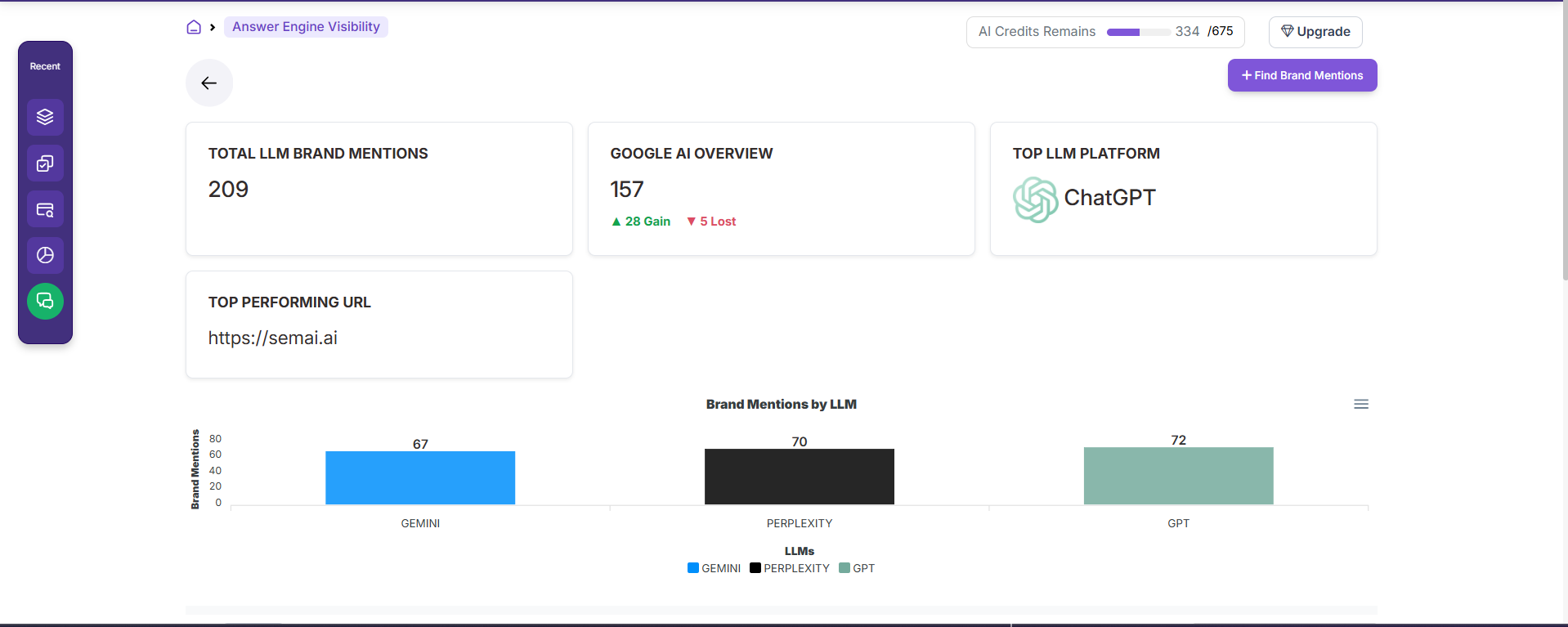
The SaaS AI Visibility Problem
SaaS buying behaviour has fundamentally shifted. Buyers research tools in AI before they visit product websites. They ask ChatGPT for recommendations, use Perplexity to compare features, and validate shortlists with Gemini. Traditional SEO metrics don't capture this.
Perplexity
Heavily cites comparison and BOFU pages to answer user queries.
ChatGPT
Cites data-backed content and structured feature breakdowns.
Gemini
Cites high-authority editorial with clear product entity signals.
The SEMAI AEO audit shows you exactly where your content falls short on each platform.
What SEMAI Tracks for SaaS
Category Visibility
How often is your product cited for category-level questions like 'best CRM for SMBs'? We monitor and classify your visibility as Weak, Average, or Strong.
Feature-Level Visibility
Buyers search by capability. We map your visibility for specific features and use-cases, like 'tool with Salesforce integration'.
Competitor Displacement
When you're not cited, a competitor is. We log who appears in your place, telling you who's winning the AI search battle in your category.
TOFU / MOFU / BOFU Visibility
We classify your visibility by funnel stage, showing if you're invisible on evaluation queries where deals are actually won.
Common Visibility Gaps in SaaS
| Query Type | Example | Most Common Gap |
|---|---|---|
| Category recommendation | 'Best tools for X' | Mentioned but low frequency |
| Competitor comparison | 'X vs Y' | Competitor owned, brand absent |
| Use case specific | 'Tool for [specific workflow]' | Feature not surfaced by LLM |
| Integration query | 'Does X integrate with Salesforce' | No structured content for LLM to cite |
| Pricing query | 'How much does X cost' | LLM cites competitor pricing pages instead |
| Problem-first query | 'How to solve [problem] in SaaS' | No thought leadership content in LLM index |
The SEMAI Content Engine for SaaS
Once visibility gaps are identified, SEMAI generates a content calendar structured around closing them. For SaaS companies, this typically means:
- Comparison pages targeting 'vs competitor' queries.
- Structured feature pages with FAQ schemas.
- Use-case editorial with named integrations and outcomes.
- Data-backed research content to establish authority.
- BOFU pages structured for evaluation stage queries.
Measuring ROI on AEO for SaaS
SEMAI's outcome-based model means you measure success in visibility improvement, not content volume. The core metrics:
- Visibility score improvement per cluster (Weak → Strong).
- Citation frequency increase per LLM over 30/60/90 days.
- Competitor displacement: queries shifted to your citation.
- BOFU visibility growth: the stage that correlates with trial requests.
When BOFU visibility improves, you appear in more AI answers at the exact moment a buyer is deciding which tool to trial. That is the direct link between AEO improvement and pipeline growth.