11 Common AEO Mistakes to Avoid (And How to Fix Them)
TL;DR:
Most businesses fail at Answer Engine Optimization not because the strategy is wrong, but because of avoidable mistakes. This guide walks through every major AEO mistake in detail what it is, why it happens, and exactly what to do instead.
Why AEO Mistakes Are More Costly Than SEO Mistakes
In traditional SEO, a mistake typically means a lower ranking. You lose some traffic, but the feedback loop is relatively fast and the correction is usually clear. In AEO, mistakes operate differently. A piece of content that is structurally wrong for AI consumption does not get a lower citation position it simply does not get cited at all. The AI engine moves past it entirely and selects a competitor's page instead.
This all-or-nothing dynamic makes AEO mistakes significantly more costly than their SEO equivalents. Understanding them clearly and building your content strategy to avoid them from the start is one of the highest-return investments you can make in your AEO practice.
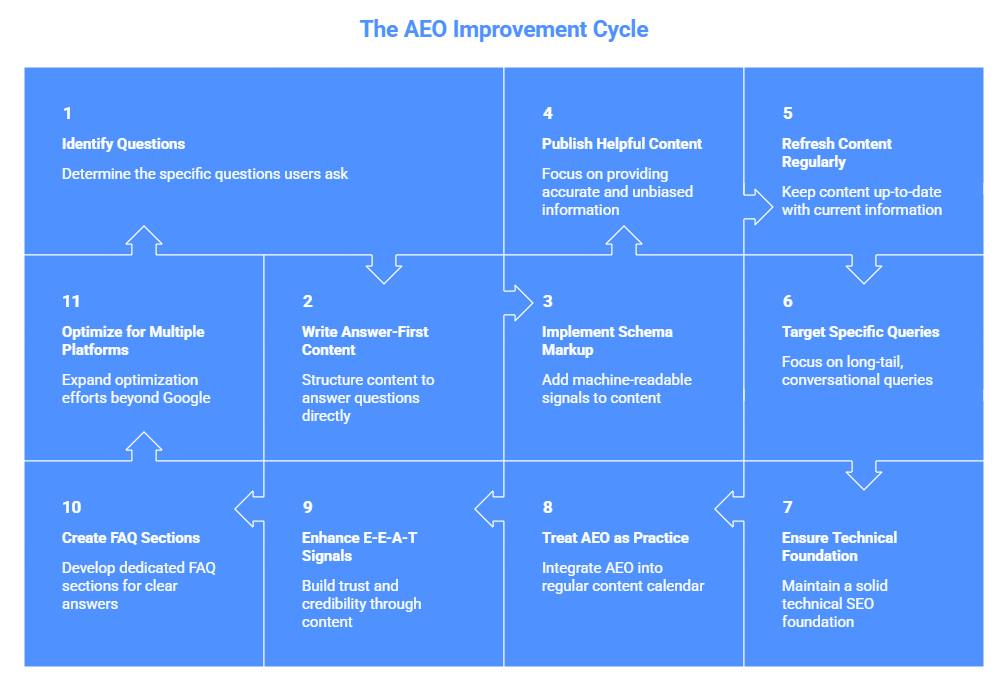
Mistake 1: Writing for Keywords Instead of Questions
One of the most widespread AEO mistakes is approaching content creation the same way you would for traditional SEO starting with a keyword and building an article around it. AI answer engines are built to respond to questions, not keywords. They evaluate content based on how directly and clearly it answers a specific query, not how many times a keyword phrase appears.
What to do instead:
- Start every content piece by identifying the exact question it is designed to answer.
- Use question-based headings throughout the article that mirror how users phrase queries in AI platforms.
- Write the answer to the main question within the first two sentences of the article and within the first two sentences of every major section.
Mistake 2: Burying the Answer Deep in the Content
A common writing habit especially in long-form content is to build context before delivering the answer. For human readers with time to spare, this works. For AI engines extracting answers in milliseconds, it is a dealbreaker. AI models scan for clear answers near the top of each section. If the answer is buried under a long preamble, the model either misidentifies the answer or skips the page entirely.
What to do instead:
- Adopt the answer-first writing model state the answer clearly, then provide supporting context.
- Treat every section heading as a question and the first sentence beneath it as the answer.
- Read your opening sentences in isolation and ask whether they answer the question without requiring the reader to scroll further.
Mistake 3: Ignoring Schema Markup Entirely
Schema markup provides AI engines with machine-readable signals about what your content contains, what questions it answers, and who produced it. FAQ schema in particular explicitly tells AI platforms the exact questions and answers on a page, making extraction effortless. Pages without schema markup force AI engines to infer structure from the content alone, increasing the chance of being overlooked.
What to do instead:
- Implement FAQ schema on every informational page that contains question-and-answer content.
- Add How-To schema on any page that walks readers through a step-by-step process.
- Use Article schema to communicate authorship, publication date, and content type to AI crawlers.
- Validate your schema implementation using Google's Rich Results Test before publishing.
Mistake 4: Publishing Promotional Instead of Helpful Content
AI answer engines are designed to provide users with accurate, unbiased information, not advertising. Content that reads like a sales pitch loaded with superlatives and light on factual substance is systematically filtered out of AI Overview consideration. The moment your content prioritises selling over informing, it disqualifies itself from AI citation.
What to do instead:
- Separate your informational AEO content from your commercial landing pages.
- Write informational content as if you have no product to sell, focusing entirely on what is true and useful.
- Remove or rewrite any section that leads with brand claims rather than factual answers.
Mistake 5: Neglecting Content Freshness
Publishing content once and leaving it untouched is one of the fastest ways to lose AEO citation share. AI platforms strongly prefer content that reflects current information. An article last updated eighteen months ago signals to the AI engine that the information may be outdated, even if the core content is still accurate.
What to do instead:
- Build a content review schedule that revisits top pages every three to six months.
- Update statistics, replace outdated examples, and add new developments.
- Display a visible 'last-updated' date on each page.
- Prioritise refreshing high-traffic pages first.
Mistake 6: Targeting Only Broad, High-Volume Keywords
High-volume keywords are intensely competitive and rarely the type of specific question that triggers an AI Overview. AI Overviews are most frequently triggered by specific, question-based queries. A niche question answered with exceptional depth and clarity can earn consistent AI citations from day one.
What to do instead:
- Build a query library of specific, question-based search terms.
- Prioritise long-tail, conversational queries over short, high-competition phrases.
- Create individual, focused content pieces for each specific question.
Mistake 7: Skipping the Technical SEO Foundation
AEO sits on top of a technical foundation that must be solid. If Google cannot crawl your page, it cannot include it in an AI Overview. If your page loads slowly, AI engines will deprioritise it. Technical issues are often invisible to content teams, which is why they can persist for so long without being fixed.
What to do instead:
- Run a full technical SEO audit using tools like SEMAI before implementing AEO changes.
- Ensure all target pages are indexed and accessible in Google Search Console.
- Achieve page load times of under three seconds on both desktop and mobile.
- Fix broken links, duplicate content, and missing meta tags.
Mistake 8: Treating AEO as a One-Time Project
AEO is a compounding strategy, not a campaign. Every new piece of optimised content adds to your topical authority and every content refresh signals trustworthiness. This compounding only works if the effort is sustained. Stopping AEO activity after an initial push is like stopping SEO after publishing your first ten articles.
What to do instead:
- Integrate AEO into your regular content calendar as an ongoing practice.
- Assign ownership of AEO performance to a specific person or team.
- Set quarterly AEO goals for both new content creation and maintenance.
- Review your AEO measurement data monthly to guide priorities.
Mistake 9: Overlooking E-E-A-T Signals
Experience, Expertise, Authoritativeness, and Trustworthiness (E-E-A-T) are pillars Google uses to evaluate a source. Google cannot reward trust signals it cannot find. Content published without a named author, on a site with no About page, citing no sources, and earning no backlinks lacks the signals AI engines require.
What to do instead:
- Add detailed author bios to every content piece that highlight real credentials.
- Build a comprehensive About page establishing your organisation's expertise.
- Cite reputable external sources within your content.
- Invest in digital PR to earn mentions and backlinks from credible publications.
Mistake 10: Not Having a Dedicated FAQ Section
A well-constructed FAQ section with proper schema markup is essentially a direct feed of question-and-answer pairs to AI engines. Voice search in particular draws heavily from FAQ-style content. Businesses without dedicated FAQ content are leaving one of the easiest AEO opportunities on the table.
What to do instead:
- Add a dedicated FAQ section to every major informational page.
- Write FAQ answers in two to four sentences: useful but short enough for clean extraction.
- Base FAQ questions on real queries from Google's 'People Also Ask' and customer data.
- Apply FAQ schema markup to every FAQ section.
Mistake 11: Optimising Only for Google
A meaningful share of AI-driven search happens on Perplexity, Microsoft Copilot, ChatGPT, and voice assistants. Businesses that optimise only for Google miss citation opportunities on platforms that are growing rapidly and, in some cases, deliver higher-quality referral traffic. Perplexity, in particular, is worth dedicated attention as it drives measurable referral traffic.
What to do instead:
- Build your AEO strategy around platform-agnostic content principles like answer-first structure and schema.
- Track your citation performance on Perplexity, Copilot, and ChatGPT alongside Google.
- Use tools like SEMAI to monitor your brand visibility across multiple AI platforms simultaneously.
Frequently Asked Questions
Final Thoughts
The businesses that get the most from AEO are not necessarily the ones with the biggest budgets. They are the ones that understand the principles behind AI source selection and apply them consistently. Every mistake covered in this article is correctable. They require a clear understanding of how AI engines evaluate content and a willingness to apply that understanding to everything you publish. Identify the mistakes most present in your current content, fix them systematically, and measure the impact. That process, repeated consistently, is what separates the brands that dominate AI answer engines from the ones still wondering why their content is not being cited.