Direct Answers vs. Featured Snippets: Key Differences and How to Win Both
TL;DR:
Most people treat these two as the same target. They are not. The strategy that earns one can fail completely on the other. This guide covers the practical gap between them and what it takes to earn each one consistently.
The Practical Gap in SEO Strategy
You already know what direct answers are and how featured snippets work. What this article covers is the practical gap between the two—how they differ in selection logic, content requirements, page position, and what it takes to earn each one consistently.
Six Core Differences That Separate Them
1. Scope and Relationship
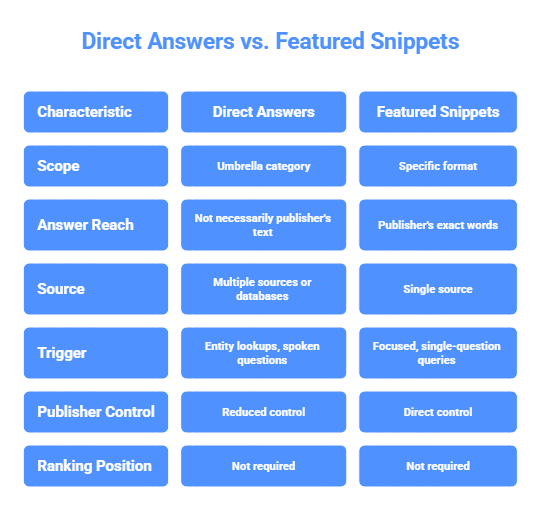
Direct answers is the umbrella category. Featured snippets are one specific format within it. Every featured snippet is a direct answer, but most direct answers are not featured snippets. Winning a featured snippet is a content formatting task, while earning broader direct answer placements is an authority and coverage task.
2. How the Answer Reaches the User
Featured snippets extract text verbatim from a single web page. The exact words you wrote appear in the snippet box. Other direct answer formats may use a structured database, a synthesised response, or a spoken summary, meaning the answer is not necessarily your exact text.
3. Single Source vs. Broader Selection
Featured snippets are winner-takes-all; one page earns the position. Broader direct answer formats can surface multiple sources or draw from databases that no individual publisher owns, making the opportunity less concentrated.
4. What Triggers Each
Featured snippets are triggered by focused, single-question queries (definitions, steps, lists). Broader direct answers are triggered by different patterns like entity lookups, voice questions, or exploratory queries with multiple sub-questions.
5. Publisher Control Over the Answer
With featured snippets, you have direct control over the phrasing, sentence structure, and wording the user sees. Other direct answer formats reduce that control, as the answer may be a summary or drawn from a database Google maintains.
6. Ranking Position Required
Featured snippets do not require a position one ranking; they can be pulled from anywhere on the first page. A well-structured answer on a page ranked sixth can outperform a vague answer on a page ranked first. This makes them highly accessible.
How to Optimise Specifically for Featured Snippets
Featured snippet selection is predictable. Google wants content it can extract cleanly, without modification, that directly answers a specific query. The key is precise formatting.
- Match your heading to the exact phrasing of the target query.
- Write the answer in the first two to three sentences immediately beneath the heading.
- Keep paragraph answers between 40 and 60 words—complete but concise.
- Use a numbered list for any process or step-by-step query.
- Use a bulleted list for any category, type, or example-based query.
- Open definitional answers with a direct sentence in the form: 'X is...'.
- Never bury the answer. Place it right after the question heading.
Crucially, the answer should be self-contained. A user reading only the snippet should receive a complete, usable response.
How to Optimise for Broader Direct Answer Placements
Winning broader direct answer positions requires a different focus. The content formatting tactics for snippets are necessary but not sufficient here. The focus shifts to authority and credibility.
- Build topical coverage across a subject, not just a single page.
- Demonstrate E-E-A-T (Experience, Expertise, Authoritativeness, and Trustworthiness).
- Earn third-party validation through high-quality backlinks.
- Keep content accurate and regularly updated.
- Use structured data markup (Schema) to help search engines understand context.
- Write in plain, clear language that is easy to process.
Where Voice Search Connects Both
Voice answers sit at the intersection of these two formats. Voice assistants often pull spoken answers from the featured snippet. Earning a featured snippet for a query significantly increases the probability of also becoming the voice answer when that same query is spoken aloud.
The one additional requirement for voice is sentence-level readability. An answer that sounds natural when read aloud performs better in voice than content that reads well on screen but becomes fragmented when spoken.
Using Both Strategies Together
The most effective approach is to build content that earns both, using a two-track approach based on query type. For focused, single-question queries, apply the featured snippet formatting strategy. For broader topic pages covering complex subjects, apply the authority and depth strategy. Mapping your target queries into these two tracks before writing is the most efficient way to ensure every piece of content is built for the format it is most likely to earn.
Frequently Asked Questions
Yes. A page can earn a featured snippet for one specific query while also being cited in other direct answer formats for different, related queries. The featured snippet is query-specific, while the page's broader authority can earn it positions across other query types simultaneously.
Not guaranteed, but it is strongly correlated. Voice assistants frequently source spoken answers from the featured snippet. Earning the snippet for a query significantly raises the probability of also capturing the voice answer for that same query.
Featured snippet selection is dynamic. A page can lose its snippet if a competitor updates their page to state the answer more clearly, if the source page is restructured, if Google reclassifies the query intent, or if the answer is flagged as inaccurate. They are not permanent positions.
Yes. Featured snippets are selected from pages across the first page of results, not exclusively from position one. A page ranking between positions 2-10 with a clearly structured answer has a realistic chance of earning the snippet. Content structure matters more than ranking position alone.
Search your target queries directly in Google. If a featured snippet box is present, the opportunity exists. If no snippet appears, it means either the query doesn't trigger them or no current result is structured well enough to earn one—both cases represent an opening for optimized content.
Final Thoughts: A Strategic Distinction
The difference between direct answers and featured snippets is a strategic one. Featured snippets reward precise formatting and short, extractable answers. Broader direct answer formats reward authority, topical depth, and credibility built over time. A content strategy that pursues both uses query type as the decision point. That alignment between content structure and target format is what separates brands that occasionally appear in direct answers from those that consistently hold those positions.