Do Direct Answers Always Come From the #1 Ranked Page?
TL;DR:
The assumption that the number one ranked page automatically earns the direct answer is one of the most widespread misconceptions in search strategy. Direct answer selection and organic ranking are evaluated independently. This article explains why and what actually determines which page earns a direct answer regardless of where it ranks.
Optimize My ContentRead FAQsThe Short Answer: No, Not Even Close
Multiple studies of direct answer selection across thousands of queries have consistently found that the page ranked first organically is chosen as the direct answer source only a minority of the time. Estimates vary by study and query category, but the pattern is consistent a substantial share of direct answers are drawn from pages ranked second, third, fourth, fifth, or lower on the same results page.
For some query categories the figure is even more striking. In definitional and procedural queries, pages ranked outside the top three are frequently selected as direct answer sources when they state the answer more clearly or in a more extractable format than the higher-ranked pages around them.
This disconnect exists because ranking and direct answer selection measure fundamentally different things. Organic ranking measures accumulated authority, relevance signals, and link equity built over time. Direct answer selection measures how precisely and cleanly a specific piece of content answers a specific query right now. A page can have enormous authority and rank first while still losing the direct answer position to a page with a cleaner, more extractable answer ranked below it.
What Direct Answer Selection Actually Measures
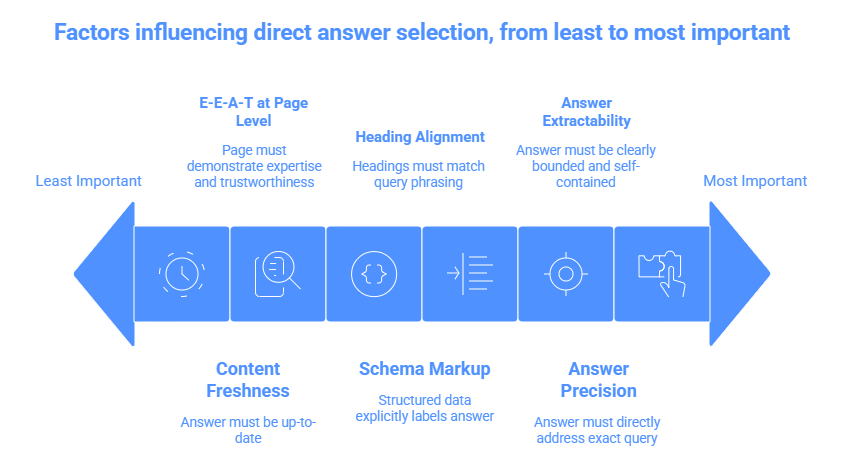
To understand why the number one page often does not earn the direct answer, it helps to understand what the selection process is actually evaluating. Search engines are not asking which page has the most authority. They are asking a much more specific question: which page states this answer most clearly and directly in a form that can be extracted and delivered to the user without requiring further context.
Answer Extractability
Extractability is the single most important factor separating pages that earn direct answers from those that do not. A page is extractable for a specific query when the answer to that query appears in a clearly bounded section of the page typically a short paragraph or list immediately beneath a heading that matches the query phrasing and when that answer is self-contained enough to be understood without the surrounding text.
A page ranked first that buries its answer mid-article, beneath three paragraphs of introduction, surrounded by related but non-essential context, is less extractable than a page ranked fourth that opens its relevant section with a direct two-sentence answer under a question-phrased heading. The fourth-ranked page wins the direct answer. The first-ranked page keeps its organic position but loses the more prominent placement above it.
Answer Precision
Precision refers to how directly the content answers the exact query as phrased, not the general topic. A page about social media marketing may rank highly for a broad range of related queries. But if a user asks what is the best time to post on Instagram, the direct answer goes to the page that most directly and specifically answers that exact question not the highest-authority page on social media strategy in general.
High-ranking pages often cover a topic broadly, which makes them strong organic performers across many queries simultaneously. But broad coverage works against direct answer selection for specific queries, because the search engine cannot easily identify where on the page the answer to any one specific question lives. Pages built to answer specific questions directly consistently outperform broader authority pages in direct answer selection for those specific queries.
Heading and Structure Alignment
Search engines use heading structure as a primary navigation tool when scanning pages for direct answer candidates. A page where the H2 or H3 heading directly mirrors the query phrasing using the same words in the same order signals clearly to the search engine that the content beneath that heading is the relevant answer location. The answer is then evaluated for extractability and precision from that section alone.
Pages that do not use question-phrased headings, or that use creative heading variations that do not closely match the query, make the search engine work harder to locate the answer. In competitive direct answer environments, that additional friction is often enough for the page to lose the position to a competitor whose heading alignment is tighter.
Content Freshness
For queries where the answer can change over time statistics, current records, prices, rankings, dates of upcoming events, regulatory requirements freshness of the answer on the page directly affects direct answer selection. A page ranked first that contains a statistic from two years ago loses the direct answer to a page ranked lower that was updated last month with current figures.
Search engines apply freshness weighting to direct answer selection that operates independently from the freshness signals used in organic ranking. A page can maintain its ranking position through accumulated authority even as its content ages but it will lose direct answer positions to fresher sources on time-sensitive queries as soon as more current content becomes available in the index.
Schema Markup and Structured Data
Schema markup is a form of on-page code that tells search engines explicitly what type of content a page contains and what role specific elements play. Pages that implement FAQ schema, HowTo schema, or definition markup give the search engine a labelled, machine-readable version of their answers removing the need for the search engine to interpret content structure from the page layout alone.
A page ranked third that implements the correct schema for its answer type has a structural advantage over a page ranked first that relies on the search engine to infer the answer location from unstructured content. Schema does not guarantee direct answer selection, but it reduces the barrier to selection significantly particularly in competitive query categories where multiple pages are strong candidates.
E-E-A-T at the Page Level
E-E-A-T experience, expertise, authoritativeness, and trustworthiness is evaluated at the page level for direct answer selection, not just at the domain level. A high-authority domain with a weak individual page can lose the direct answer to a lower-authority domain whose specific page on the topic demonstrates clearer expertise through author credentials, cited sources, accurate technical detail, and content that reflects direct experience with the subject.
This page-level E-E-A-T evaluation means that even well-established brands can lose direct answer positions on specific topics to specialist sources whose domain authority is lower but whose individual content quality and demonstrated expertise on that exact topic is higher.
Why Number One Pages Lose Direct Answer Positions
Understanding the specific reasons number one ranked pages lose direct answer positions helps identify exactly what needs to change for a page to recover or capture that position.
The Answer Is Not in the Right Place on the Page
Many high-ranking pages are structured for comprehensive coverage rather than for direct answer extraction. They open with an introduction, provide background context, build toward the answer gradually, and deliver the key information somewhere in the middle of the article. This structure serves readers who arrive on the page and read through but it fails the direct answer extraction test, because the search engine cannot easily identify a clean, bounded passage to pull.
The number one page keeps its ranking because authority and relevance signals are still strong. But the direct answer goes to a page that leads with its answer rather than building toward it.
The Page Covers Too Many Topics
Broad, comprehensive pages that cover an entire subject area rank well because they attract links and traffic across many related queries. But for any single specific query within that subject, the answer competes for space on a page that also covers many other things. The search engine evaluates the page as a weak direct answer candidate for the specific query because the relevant section is a small part of a large page rather than the clear focus of a dedicated answer.
A shorter, more focused page built specifically to answer one category of question even if it has less overall authority consistently outperforms broad comprehensive pages in direct answer selection for those specific queries.
The Page Has Not Been Updated
Pages that earned their number one ranking through years of accumulated links and authority can sit at the top of results while their content slowly ages. For stable, evergreen topics this is not a problem. For any query where the answer evolves statistics, best practices, legal requirements, software instructions, pricing the aging content becomes a liability in direct answer competition even as it maintains its organic position.
Competitors who publish or update content with current information will take direct answer positions away from the stale number one page, query by query, until a pattern of content freshness maintenance is established.
Competitors Have Better Structured Content
Even without updating, a number one page can lose direct answer positions to competitors who simply structure their content more deliberately for extraction. If a competing page uses question-phrased headings, opens each section with a direct answer sentence, uses numbered lists for process content, uses bulleted lists for category content, and implements the appropriate schema markup it presents the search engine with a far cleaner extraction opportunity than an unstructured page of equivalent or higher authority.
This is the most actionable insight in the entire direct answer space: structural improvements to existing content can capture direct answer positions from higher-authority pages without any increase in backlinks, domain authority, or search ranking. The win comes from making the answer easier to extract, not from outranking the competition.
How Lower-Ranked Pages Win Direct Answer Positions
The practical implication of everything covered so far is that lower-ranked pages can and regularly do win direct answer positions. The conditions under which this happens reveal the precise levers available to content creators who want to compete for direct answers without first reaching position one.
- A page ranked between two and ten with a question-phrased heading, a direct opening answer, and clean list formatting can win the direct answer over a page ranked first with unstructured content on the same topic.
- A recently updated page ranked fifth can win the direct answer on a freshness-sensitive query over a page ranked first with content that has not been updated in twelve months.
- A specialist page on a niche topic with clear author expertise signals and cited sources can win the direct answer over a broader authority page from a larger domain that covers the topic less specifically.
- A page with FAQ or HowTo schema can win the direct answer on applicable query types over a higher-ranked page with no schema implementation, because the structured markup makes extraction trivial for the search engine.
- A page with a highly specific answer to a long-tail query can win the direct answer even from a much lower ranking position, because the answer precision match is stronger than anything offered by more broadly focused higher-ranked pages.
What This Means for Your Content Strategy
The disconnect between organic ranking and direct answer selection has significant strategic implications. It means that direct answer optimisation and SEO, while related, require separate and distinct investment.
A brand that ranks well but has not invested in direct answer optimisation is leaving prominent positions above its own organic results available for competitors to win. A brand that ranks lower but builds content with deliberate direct answer structure can capture top-of-page visibility for specific queries without waiting to outrank the competition.
The most effective approach combines both. Pursue organic ranking through authority, links, and relevance signals. Pursue direct answer positions through content structure, answer precision, freshness maintenance, schema markup, and page-level E-E-A-T. Treat them as parallel strategies that reinforce each other rather than assuming one automatically delivers the other.
- Audit your ranking pages for direct answer structure. Identify which pages rank well but lack question-phrased headings, direct opening answers, or clean list formatting. These are the pages with the highest direct answer capture potential from structural improvements alone.
- Prioritise freshness on time-sensitive topics. Any page covering statistics, current practices, or evolving requirements needs a defined update schedule to maintain direct answer positions on freshness-sensitive queries.
- Implement schema markup on every page where the content type maps to an available schema FAQ, HowTo, definition, article. This is the lowest-effort structural improvement with the most direct impact on direct answer selection eligibility.
- Build focused answer pages for your highest-value query categories rather than relying on broad comprehensive articles to capture direct answers for specific queries within a topic.
- Monitor direct answer positions separately from organic rankings. A ranking tracker that shows position one does not tell you whether you hold the direct answer above position one. These need to be tracked independently to understand the full picture of your search visibility.
Frequently Asked Questions
Research across multiple studies consistently shows that fewer than half of direct answers come from the page ranked first organically and in some query categories the figure is considerably lower. The exact percentage varies by query type, topic area, and the structural quality of competing pages. What is consistent across all studies is the finding that organic ranking position is a poor predictor of direct answer selection compared to content structure and answer clarity.
Yes, though it is uncommon. Pages on the second page of results are rarely selected as direct answer sources because the search engine evaluates direct answer candidates primarily from the pages it has already assessed as most relevant for the query which are predominantly the pages on page one. However, for highly specific long-tail queries with very little competition, a clearly structured page on page two can occasionally earn the direct answer if no page on page one answers the query with comparable precision and extractability.
Direct answer positions consistently drive higher click-through rates for the credited source than position one organic rankings for the same query, because the direct answer occupies a more prominent position and carries an implicit trust endorsement from the search engine. However, the relationship between direct answers and traffic is nuanced some users read the direct answer and do not click through, while others use it as a signal to visit the source page. Net traffic impact depends on the query type and how fully the direct answer satisfies the user's need.
The timeline depends on how frequently the search engine crawls the page after the structural improvements are made. For pages on high-authority domains with frequent crawl schedules, structural improvements can be reflected in direct answer selection within days to a few weeks. For pages on lower-authority domains with less frequent crawl cycles, the timeline may extend to several weeks or months. Submitting the updated URL through Google Search Console immediately after improvements are made accelerates the initial recrawl.
Losing a direct answer position does not directly affect organic ranking. The two evaluations are independent. A page that loses its direct answer position to a competitor retains its organic ranking position unchanged. The loss affects visibility and traffic from that specific query but does not trigger a ranking penalty or reduction. Equally, a page that wins a direct answer without ranking first does not receive a ranking boost the organic and direct answer positions remain independently determined.
Not every page is a realistic direct answer candidate. Pages targeting navigational, transactional, or highly contested queries are unlikely to earn direct answer positions regardless of their structure. The most effective approach is to identify the informational, question-based queries within your topic area where direct answers are already being awarded, then focus structural optimisation effort on the pages targeting those queries. Applying direct answer structure broadly across all pages is low-risk but prioritising pages with genuine direct answer potential delivers faster and more measurable results.
Final Thoughts
Direct answers do not follow rank. They follow structure, precision, freshness, schema, and page-level expertise. A page ranked first with unstructured content loses the direct answer position to a page ranked fifth with a clear question heading, a direct opening answer, and clean formatting every time.
This is one of the most consequential facts in modern search strategy. It means the direct answer position above position one is not reserved for whoever has worked hardest to rank first. It is available to whoever has built their content most deliberately for extraction. That is an entirely different competition and one that smaller, newer, or lower-authority pages can win right now, without waiting to outrank anyone.
Know what direct answer selection actually measures. Audit your content against those criteria. Make the structural changes that bring your pages into alignment with them. The direct answer position is not a reward for ranking. It is a reward for answering.
Rank earns you a place in the list. Structure earns you the position above it. Build for both.