What Is an Entity in AEO and Why Does It Matter?
TL;DR:
'Google no longer searches for words. It searches for things. The shift from matching strings of text to understanding real-world entities is the most fundamental change in how search works and it changes everything about how AEO content should be built.'
Understanding entities is not optional for anyone building a serious AEO strategy. Entities are the foundation of how modern search engines understand content, evaluate authority, and decide whose answers to trust. This article explains what an entity is, how Google builds its understanding of entities, the types of entities that matter in AEO, how entity relationships affect content eligibility, and what businesses need to do to establish strong entity status.
Entities: Things, Not Strings
An entity is a distinct, uniquely identifiable thing that exists in the real world or in a defined knowledge domain. It can be a person, a place, an organisation, a concept, a product, an event, or a creative work. What makes something an entity is not how it is spelled or named it is that it exists as a singular, recognisable thing with defined properties and relationships to other things.
Google's shift toward entity-based understanding is captured in a phrase the company used when introducing the Knowledge Graph: things, not strings. A string is a sequence of characters the letters that make up a word or phrase. A thing is the real-world object, concept, or idea those letters refer to. When Google understood only strings, it matched the words in a query to the words on a page. When Google understands things, it matches the concept behind the query to the concept represented by the content regardless of whether the exact same words are used.
This distinction matters profoundly for AEO. A page optimised for a string a specific keyword phrase is visible only when those exact words are searched. A page that Google associates with an entity is eligible to appear across every query variation, synonym, related concept, and contextual question that connects to that entity even if those queries use completely different words. Entity association expands content eligibility far beyond what keyword targeting alone can achieve.
How Google Builds Its Understanding of Entities
Subject-Predicate-Object Triples
Google organises entity knowledge in a structure called a knowledge graph, built from units of information called triples. Each triple takes the form: subject predicate object. The subject is an entity. The predicate is a relationship or attribute. The object is either another entity or a value.
For example: Albert Einstein born in Ulm. Apple Inc founded by Steve Jobs. Content marketing is a type of digital marketing. Each triple is a single fact about an entity and its relationship to another entity or property. The knowledge graph is built from billions of such triples, connecting entities to each other through a web of verified relationships and attributes. When Google answers a question about an entity, it is reading these triples not scanning web pages for keyword matches.
How Google Populates Entity Knowledge
Google builds its entity knowledge from multiple sources simultaneously. Structured databases Wikipedia, Wikidata, Freebase, government records, and verified data partners provide the authoritative foundation. Web content across millions of pages contributes corroborating signals. Schema markup on websites provides publisher-declared entity data. User interactions and search pattern analysis reveal which entities users associate with which queries.
The more sources independently confirm the same facts about an entity, the higher Google's confidence in those facts and the more prominently that entity features in direct answers, knowledge panels, and AI-generated responses. An entity that appears in one source is noted. An entity confirmed consistently across dozens of authoritative sources is established.
Entity Disambiguation
Many entities share names or are easily confused. Mercury is a planet, a chemical element, a Roman god, a car brand, and a record label. Apple is a technology company and a fruit. Google resolves this ambiguity through context signals the query's surrounding words, the user's search history, the content of the page being evaluated, and the strength of each entity's association with the query topic.
For businesses and individuals, disambiguation matters because a weak or ambiguous entity profile means Google may not confidently identify which entity a website or piece of content refers to. Content on a page about Mercury the planet will not help a car dealership's entity recognition even if both happen to use the same word. Clear, unambiguous entity signals in content, schema, and off-site references ensure Google associates the content with the correct entity.
The Seven Entity Types That Matter in AEO
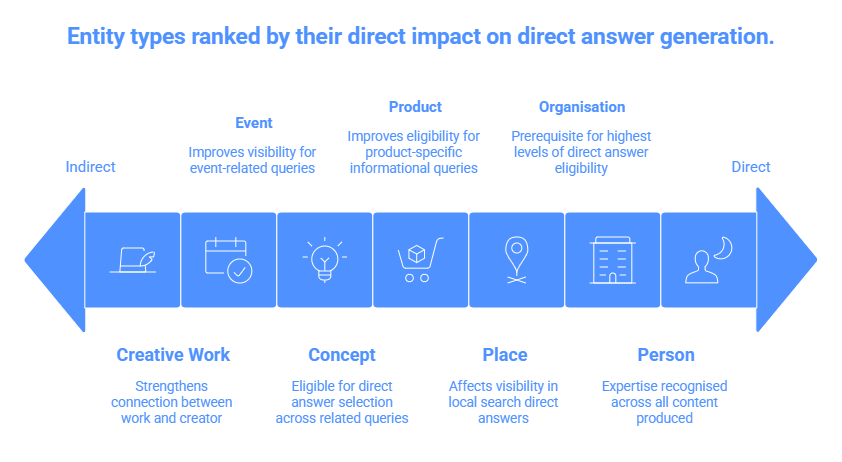
Google's entity taxonomy is extensive, but the following seven types are the most directly relevant to AEO strategy. Each behaves differently in direct answer generation and requires a different approach to establish and strengthen.
1. Person
A person entity is a named individual an author, a founder, a public figure, an expert, or any named human being that Google has enough information to represent as a distinct entry in its knowledge graph. Person entities are referenced in biographical direct answers, author attribution signals, and expert credibility evaluations. For content creators and thought leaders, establishing a strong person entity is the mechanism by which their expertise is recognised across every piece of content they produce not just the pages that mention their name explicitly.
2. Organisation
An organisation entity is a named company, institution, charity, government body, or group. Organisation entities power knowledge panels for businesses, influence brand-related direct answers, and determine whether a publisher's content is evaluated with the credibility of a known, established entity or as anonymous unverified content. For any business publishing content for AEO purposes, organisation entity status is a prerequisite for the highest levels of direct answer eligibility.
3. Place
A place entity is a named geographic location a country, city, region, landmark, or address. Place entities are central to local direct answers, where Google matches a query's geographic intent with the most relevant local entity. For businesses with physical locations, place entity clarity ensuring Google correctly associates the business with its location directly affects visibility in local search direct answers.
4. Concept
A concept entity is an abstract idea, principle, field of knowledge, or defined term that Google has established as a distinct thing with its own properties and relationships. Content marketing, machine learning, cognitive bias, and inflation are all concept entities. For AEO content, concept entities are the most common targets definitional queries, explanatory queries, and how-to queries are all ultimately requests for information about concept entities. Content that Google strongly associates with a specific concept entity is eligible for direct answer selection across all queries related to that concept.
5. Product
A product entity is a named, commercially available item a piece of software, a physical product, a service offering, or a platform. Product entities appear in comparison direct answers, feature-specific queries, pricing queries, and review-based queries. For businesses whose products are distinct enough to be recognised as individual entities by Google, strong product entity status improves direct answer eligibility for all product-specific informational queries.
6. Event
An event entity is a named, scheduled occurrence a conference, a sporting fixture, an election, a product launch, or a historical occurrence. Event entities are referenced in temporal direct answers and event-specific information panels. For organisations that run events or publish event coverage, establishing event entities through consistent naming, date attribution, and structured data markup improves direct answer visibility for event-related queries.
7. Creative Work
A creative work entity is a named book, film, article, research paper, podcast, or other produced content. Creative work entities appear in direct answers about authorship, publication details, and content recommendations. For publishers and content creators, establishing their output as recognised creative work entities strengthens the connection between their published work and their author or organisation entity.
Entity Attributes and Relationships: What Google Knows About Each Entity
Every entity in Google's knowledge graph has two types of information associated with it: attributes and relationships. Attributes are properties that describe the entity itself a company's founding date, headquarters city, industry category, and number of employees. Relationships are connections between entities the company was founded by this person, operates in this industry, is headquartered in this city, and produces this product.
The richness of an entity's attributes and relationships in the knowledge graph determines how confidently Google can answer questions about it, associate it with related queries, and surface it in direct answers. An entity with few confirmed attributes and relationships is weakly established Google can identify it exists but knows little about it. An entity with extensive, well-sourced attributes and clear relationships to other well-established entities is strongly established and eligible for a much broader range of direct answer appearances.
For AEO strategy, this means that building entity strength is not only about getting the entity recognised. It is about expanding the attributes and relationships Google knows about the entity so that it becomes relevant to a wider range of queries and more confidently selected as a direct answer source across all of them.
Entity Salience: How Strongly Google Associates Content With an Entity
Entity salience refers to how prominently and clearly a specific entity features in a piece of content how central it is to what the page is about, as opposed to being merely mentioned in passing. Google measures salience as part of its evaluation of whether a page is the best source of information about a given entity.
A page where a specific entity is the clear, unambiguous focus of the entire content named in the title, discussed in depth throughout, referenced consistently using its canonical name has high salience for that entity. A page that mentions the entity briefly in one paragraph among many other subjects has low salience. High-salience content is far more likely to be selected as a direct answer source for queries about that entity than low-salience content of equivalent length and quality.
The practical implication for content planning is to build pages that are clearly about one entity rather than pages that mention many entities lightly. A dedicated page explaining a specific concept entity in depth has higher salience for that concept and stronger direct answer eligibility than a comprehensive guide that covers twenty related concepts briefly. Focus produces stronger entity signals than breadth.
Entity Co-Occurrence and Its Role in Topical Authority
Entity co-occurrence refers to the pattern of which entities appear together across a website's content. When a website consistently publishes content that mentions a specific cluster of related entities together the entities that naturally appear in the same knowledge domain Google interprets this as a signal that the website has genuine expertise in that domain.
A website that consistently co-occurs the entities of content marketing, editorial calendar, audience persona, lead generation, and conversion funnel is signalling deep familiarity with the content marketing knowledge domain. A website that mentions these entities rarely or inconsistently is signalling shallow coverage. The co-occurrence pattern across the site, accumulated over time, is one of the inputs Google uses to assess topical authority which in turn affects direct answer eligibility across the entire topic area.
This is why content clustering strategies building multiple interlinked pages across a topic area work at the entity level as well as the keyword level. Each page adds entity co-occurrence evidence to the site's topical profile, strengthening the overall signal that the site is a credible, established source of information about the entities in that domain.
How to Build and Strengthen Entity Status for AEO
Entity status is not claimed it is established through consistent, corroborated signals across multiple sources over time. The following actions are the most effective for building entity strength relevant to AEO.
- Create and maintain a Wikipedia or Wikidata entry for your organisation, key individuals, and products where notability criteria are met. These are the highest-authority entity data sources Google draws from.
- Implement Organisation and Person schema on your website with complete, accurate property values that exactly match the information in your external entity sources.
- Ensure your entity name is used consistently across every platform where it appears your website, Google Business Profile, social media profiles, press coverage, and directory listings. Variations in how the entity name is written create disambiguation uncertainty.
- Earn mentions in authoritative third-party sources industry publications, professional associations, academic references, and news coverage. Each independent mention strengthens the corroboration of your entity's attributes.
- Write about your core concept entities in depth across multiple dedicated pages. High-salience, single-entity-focused content builds the knowledge association between your website and those concepts more effectively than broad coverage of many entities.
- Use the canonical name of target entities consistently throughout your content. Avoid synonyms, abbreviations, and informal variations in entity-focused sections canonical naming reinforces entity recognition signals.
Frequently Asked Questions
A keyword is a string of characters that appears in a query. An entity is the real-world thing the query is about. A keyword-based strategy targets specific word combinations and is limited to queries that use those exact words. An entity-based strategy associates content with a recognised thing making it eligible across every query variation, synonym, and contextually related question that references that entity, regardless of the exact words used. Entity-based content has significantly broader query eligibility than keyword-optimised content covering the same subject.
Search your business name directly in Google. If a knowledge panel appears on the right side of the results page, your business has entity recognition in Google's knowledge graph. If no knowledge panel appears, your entity is either not yet established or not sufficiently confirmed across authoritative sources. Checking whether your business appears in Google's structured data testing tools with correctly interpreted Organisation schema is a secondary indicator. The presence or absence of entity-specific direct answers about your business hours, location, founding details also signals the level of entity recognition Google has assigned.
Yes, directly. Content published by or about a strongly established entity is evaluated with higher baseline credibility than equivalent content without entity association. This affects the pool of direct answer queries a page is considered for, the confidence Google assigns to the content as a direct answer source, and the breadth of query variations the content is eligible to answer. Weak entity status does not prevent direct answer selection entirely, but it raises the content quality and authority threshold the page must meet to be selected.
Entity recognition builds gradually as corroborating signals accumulate across multiple independent sources. A business that simultaneously creates a Wikipedia entry, implements complete Organisation schema, earns coverage in industry publications, and maintains consistent identity information across all platforms can begin to see entity recognition signals such as knowledge panel appearance within a few months. For less prominent entities or those in highly competitive knowledge domains, the timeline extends as more corroboration is needed to establish the entity with sufficient confidence.
Yes. Concept entities are among the most valuable targets in AEO because they underpin definitional, explanatory, and educational direct answers the query types that trigger direct answers most frequently. A website that Google strongly associates with a specific concept entity through consistent, high-salience content on that concept, corroborated by external references using the same terminology is eligible for direct answer selection across the full range of queries about that concept. Building concept entity association is the content strategy equivalent of building keyword rankings, but at the semantic level.
Final Thoughts
Entities are the language Google uses to understand the world. Moving from keyword thinking to entity thinking is not a tactical adjustment it is a strategic reorientation of how content is planned, written, and positioned. Keywords target queries. Entities establish eligibility across entire knowledge domains.
A business that builds strong entity recognition for itself as an organisation, for its key people as persons, and for its core subjects as concept entities creates an AEO foundation that compounds over time. Each piece of content adds to the entity's established attributes and relationships. Each external mention reinforces its corroboration. Each direct answer earned strengthens the association between the entity and the queries it answers.
Build the entity first. The direct answers follow from it.
Google answers questions about things it knows. Make sure it knows your thing clearly, consistently, and across every source that matters.