How Is AEO Different from Traditional SEO?
TL;DR:
Traditional SEO optimizes your content to rank in a list of search results so users click your link. AEO (Answer Engine Optimization) optimizes your content to be cited inside a single AI-generated answer on platforms like ChatGPT, Perplexity, and Google AI Overviews. SEO competes for a position in a list. AEO competes to be the chosen source. In 2026, you need both.
1. The Core Distinction: Option vs. Source
For two decades, the goal of digital marketing was simple: rank on page one of Google, get clicks, earn revenue. Traditional SEO was built entirely around that model ten blue links, user scrolls, user chooses, user clicks. That model is no longer the only one that matters. When a user opens ChatGPT, Perplexity, or Google AI Overviews and asks a question, they do not get ten links to choose from. They get one synthesised answer. The AI chose for them. That shift from option to source is the single most important difference between SEO and AEO, and every other difference between the two disciplines flows from it.
The Core Shift in One Sentence
SEO: Your brand is one of ten options the user can choose from.
AEO: Your brand is the answer the AI delivers or it is invisible.
2. Why This Distinction Matters Right Now
This is not a future trend to plan for. The shift is already happening at scale:
60%
of US searches in 2026 already end without a single click the answer is delivered directly on the results page (Icecube Digital, 2026).
25%
drop in traditional organic search volume predicted by Gartner by end of 2026 as users migrate to AI chatbots and virtual assistants.
4.4x
higher conversion rate for visitors arriving via AI citations vs. standard organic search (Semrush, 2025).
38%
of adults aged 18-29 now use AI tools as their primary method for accessing information (Pew Research Center, March 2026).
The implication is clear: a strategy built only on SEO rankings is already leaving a significant share of your potential audience unreached. Those users are asking questions inside AI platforms and the brands with strong AEO are being cited. The brands without it are invisible.
3. How the User Journey Has Changed
Understanding the difference requires understanding how user behaviour has shifted. The table below compares the traditional search journey with the AI search journey:
| Stage | User Behaviour in SEO World | User Behaviour in AEO World |
|---|---|---|
| Need arises | Opens Google, types keyword | Opens ChatGPT / Perplexity, asks a full question |
| Gets results | Sees list of 10 blue links | Receives a single synthesised answer with citations |
| Explores options | Clicks 2-5 results, compares | Reads the AI answer may not click anything |
| Forms opinion | Based on content they read on your page | Based on how AI described and cited your brand |
| Takes action | Returns to Google or visits your site | Searches branded term or clicks directly from citation |
| Converts | Via your landing page | High-intent already pre-qualified by AI recommendation |
The most important change is at the 'forms opinion' stage. In traditional search, a user visits your page and you control the narrative. In AI search, the AI describes your brand on your behalf and your content must shape that description before the user ever reaches your site.
4. Seven Key Differences, Explained in Depth
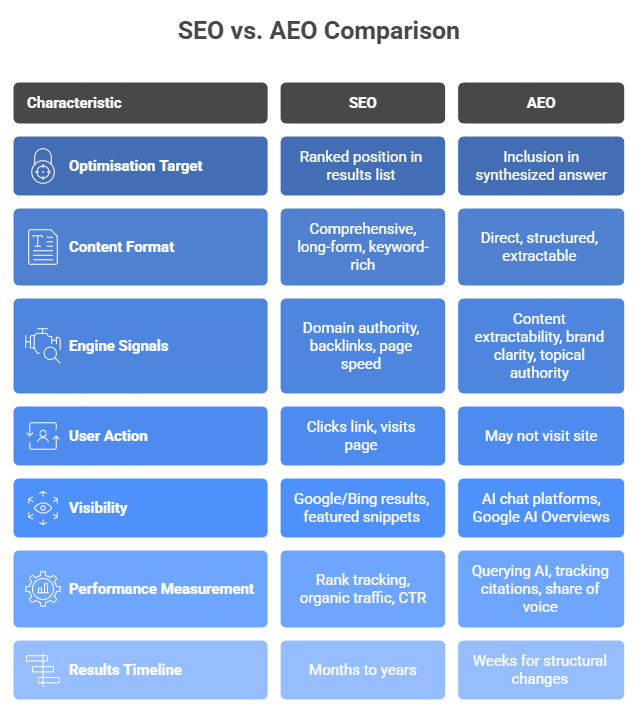
Difference 1: What You Are Optimising For
SEO: A ranked position in a results list,
measured by traffic and click-through rate.
AEO: Inclusion and accurate
representation inside a synthesised answer, measured by citation frequency and share of
voice.
The goal of SEO is to be one of the best options. The goal of AEO is to be the
chosen source. These require different content strategies, different measurement frameworks,
and different definitions of success.
Difference 2: Content Format Rewards
SEO: Rewards comprehensive, long-form,
keyword-rich content. The traditional skyscraper approach cover everything, rank for
everything.
AEO: Rewards information density. Direct answer blocks,
question-based headings, Q&A sections, and structured tables that an AI can extract
without scanning 2,000 words.
The most effective approach in 2026 combines both: a direct
answer at the top for AEO extraction, followed by comprehensive depth for SEO authority. A
page built only for SEO may rank but fail to be cited. A page built only for AEO may be
cited but too thin to build authority.
Difference 3: Ranking Signals vs. Citation Signals
The signals each system uses to select content are fundamentally different:
| Signal Type | Matters for SEO? | Matters for AEO? | Priority |
|---|---|---|---|
| Backlinks & domain authority | Critical | Foundation only | SEO first |
| Keyword placement & density | Critical | Minimal impact | SEO only |
| FAQPage / HowTo schema markup | Helpful | Critical | AEO first |
| Direct answer block (50-80 words) | Helpful | Critical | AEO first |
| E-E-A-T (author, credentials, sources) | Important | Critical | Both |
| Core Web Vitals (page speed, CLS) | Ranking factor | Trust signal | SEO first |
| Question-based headings (H2/H3) | Helpful | Critical | AEO first |
| Entity mentions on 3rd-party sites | Indirect | Critical | AEO first |
| Cited statistics with source links | Helpful | Critical | AEO first |
| Content freshness / update date | Important | Critical | Both |
| Internal linking structure | Important | Helpful | SEO first |
Difference 4: What the User Does Next
SEO: The user clicks your link and visits your
page. You control the full experience from that point.
AEO: The user
reads the AI answer and may never visit your site. Your brand shapes their perception
without a page view.
This does not mean AEO delivers less value. Users arriving from AI
citations are pre-qualified the AI has already vouched for your authority before they
arrive. This is why AI-referred traffic converts at 4.4x the rate of standard organic
visits, even at lower volume.
Difference 5: Where Your Brand Is Visible
SEO: Google and Bing results pages, featured
snippets, People Also Ask boxes.
AEO: ChatGPT (59.9% of AI search market
share), Microsoft Copilot (14.3%), Perplexity, Google AI Overviews, Gemini, and voice
assistants including Siri and Alexa.
A brand optimised for SEO but not AEO is visible to
users who start their research on Google, but invisible to users who start it on ChatGPT. In
2026, with 31% of US adults interacting with AI multiple times daily, that is a significant
audience gap.
Difference 6: How Performance Is Measured
• SEO metrics: keyword rankings, organic
sessions, click-through rate, time on page, conversions from organic traffic
•
AEO metrics: citation frequency, share of voice, brand mention accuracy, AI
referral traffic in GA4
AEO measurement requires a different process: manually querying
AI platforms with your target questions, or using tools like SEMAI, Frase, or Semrush's AI
Visibility report to track citation rates across platforms at scale.
Difference 7: How Quickly Results Materialise
SEO: Authority builds over months to years.
New pages typically need 3-6 months before meaningful organic
traffic.
AEO: Structural changes adding direct answer blocks, schema
markup, and FAQ sections can influence citations within 2-4 weeks of re-indexing. However,
building deep topical authority and consistent brand entity presence takes similar long-term
commitment.
AEO positions can also shift faster than SEO rankings. A competitor who
restructures their content for AEO can displace you in AI citations faster than they could
ever overtake you in organic rankings. This is both an opportunity and a risk.
5. Why SEO Alone Is No Longer Sufficient
Relying solely on traditional SEO in 2026 leaves three specific gaps in your visibility:
- Zero-click search is accelerating: Google AI Overviews now satisfy user intent on the results page, eliminating the need for a click. A study of 700,000 keywords found non-branded keyword CTR drops of nearly 20% when AI Overviews are present (Amsive, 2026).
- B2B buyer research has moved: Decision-makers use ChatGPT and Perplexity as their first step to research vendors. By the time they reach Google, their consideration set is already forming based on what AI told them.
- Citation authority compounds early: Brands that establish AEO presence now are harder to displace as AI models retrain on newer data. The cost of waiting increases over time.
The Strategic Conclusion
SEO ensures your brand is findable when buyers search. AEO ensures your brand is cited when buyers ask. Both user behaviours now coexist and the share of research happening inside AI platforms is growing faster than any previous shift in search behaviour.
6. A Practical Starting Point: Running Both Together
Integrating AEO does not require abandoning SEO. It requires layering a new set of optimisations onto your existing SEO foundation. Here is a six-step process to begin:
| # | Action | What to Do |
|---|---|---|
| 1 | Audit your AI position | Search your top 10 buyer questions on ChatGPT, Perplexity, and Google AI Overviews. Document which competitors appear. This is your baseline. |
| 2 | Restructure existing pages | Take your best-ranking SEO pages and add: (a) a 50-word direct answer block at the top, (b) question-based H2/H3 headings, (c) an FAQ section with 8+ pairs. |
| 3 | Implement schema markup | Add FAQPage and Article JSON-LD schema to every priority page. Use HowTo schema for process content. This is the single highest-ROI technical change for AEO. |
| 4 | Build brand entity clarity | Ensure your brand is described consistently on LinkedIn, G2, Capterra, industry directories, and Reddit. AI engines cross-reference these to validate authority. |
| 5 | Fill question content gaps | Create new content targeting the long-tail conversational questions your SEO strategy ignored: 'how to,' 'what is the best,' 'can I,' 'why does.' |
| 6 | Measure monthly | Query 15-20 target prompts across AI platforms every month. Track citation frequency, brand accuracy, and share of voice vs. competitors. |
7. Where Does GEO Fit In?
You may have encountered a third acronym: GEO, or Generative Engine Optimization. Here is how all three fit together:
- SEO: Optimising your website to rank in traditional search engine results pages. Foundation layer.
- AEO: Optimising your content to be extracted and cited as a direct answer in AI-generated responses. Content layer.
- GEO: Optimising your entire brand presence so generative AI models treat you as a trusted, authoritative source across all topics in your domain. Brand layer.
GEO is the broadest of the three. It covers off-site entity mentions, community presence on Reddit and LinkedIn, PR citations, and consistent brand description across every touchpoint the AI might read. SEMAI's AEO and GEO tools address all three layers together.
8. Frequently Asked Questions
FAQPage Schema Markup: Copy and Implement
Paste this JSON-LD into your page's <head> tag. Add one block per FAQ pair:
<script type='application/ld+json'> { '@context': 'https://schema.org', '@type': 'FAQPage', 'mainEntity': [ { '@type': 'Question', 'name': 'What is the main difference between AEO and traditional SEO?', 'acceptedAnswer': { '@type': 'Answer', 'text': 'SEO optimizes content to rank in search results for clicks. AEO optimizes content to be cited inside AI-generated answers. SEO competes for position; AEO competes to be the source.' } }, { '@type': 'Question', 'name': 'Does AEO replace SEO?', 'acceptedAnswer': { '@type': 'Answer', 'text': 'No. AEO extends SEO. Traditional SEO builds the crawlability, authority, and indexability that AI engines depend on. Without SEO, AI systems will not find your content. Without AEO, they will not use it.' } }, { '@type': 'Question', 'name': 'Can the same content rank in both SEO and AEO?', 'acceptedAnswer': { '@type': 'Answer', 'text': 'Yes, with the right structure. Content that opens with a 50-word direct answer, uses question-based headings, includes an FAQ section, and cites verifiable data performs well in both traditional search rankings and AI citation.' } }, { '@type': 'Question', 'name': 'Does ranking #1 on Google mean I will be cited by AI?', 'acceptedAnswer': { '@type': 'Answer', 'text': 'Not automatically. Many top-ranking pages are passed over by AI engines because their answers are buried inside long paragraphs. AI systems prefer a lower-ranking page with a clear, extractable answer.' } }, { '@type': 'Question', 'name': 'What signals does AEO rely on that SEO does not?', 'acceptedAnswer': { '@type': 'Answer', 'text': 'AEO weights content extractability, brand entity consistency across third-party platforms, structured data like FAQPage and HowTo schema, and off-site mentions on trusted platforms like Reddit and industry publications.' } }, { '@type': 'Question', 'name': 'How is AEO performance measured?', 'acceptedAnswer': { '@type': 'Answer', 'text': 'AEO is measured by querying AI platforms directly and tracking citation frequency, brand accuracy, and share of voice. Tools like SEMAI automate this.' } }, { '@type': 'Question', 'name': 'How quickly do AEO improvements show results?', 'acceptedAnswer': { '@type': 'Answer', 'text': 'Structural changes such as direct answer blocks and schema markup can influence AI citations within 2-4 weeks of re-indexing. Building broad topical authority takes longer, typically 2-4 months.' } }, { '@type': 'Question', 'name': 'Is AEO worth it if I already have strong SEO rankings?', 'acceptedAnswer': { '@type': 'Answer', 'text': 'Yes. Strong SEO rankings do not protect you from being bypassed in AI-generated answers. A competitor with lower rankings but better AEO structure will be cited instead of you as AI search grows.' } }, { '@type': 'Question', 'name': 'What content format works best for both SEO and AEO?', 'acceptedAnswer': { '@type': 'Answer', 'text': 'A hybrid format: a 50-word direct answer at the top, question-based H2/H3 headings, concise paragraphs, bullet points, a comparison table, and an FAQ section with schema markup.' } }, { '@type': 'Question', 'name': 'How does AEO affect zero-click searches?', 'acceptedAnswer': { '@type': 'Answer', 'text': 'AEO is designed for zero-click environments. While it may reduce page visits, brand visibility in AI answers drives higher-intent traffic, with AI-referred visitors converting at 4.4x the rate of standard organic visitors.' } }, { '@type': 'Question', 'name': 'What schema markup should I implement for AEO?', 'acceptedAnswer': { '@type': 'Answer', 'text': 'Implement FAQPage schema for Q&A, HowTo schema for processes, Article schema for editorial content, and Organization schema with sameAs links. Use JSON-LD format in the page head.' } }, { '@type': 'Question', 'name': 'How do I know if AI engines are citing my content?', 'acceptedAnswer': { '@type': 'Answer', 'text': 'Search your most important buyer questions on ChatGPT, Perplexity, and Google AI Overviews. Note if your brand appears and if the information is accurate. Repeat monthly. Tools like SEMAI automate this monitoring.' } } ] } </script>Ready to Optimise for Both SEO and AEO?
Understanding the difference is the first step. The second is auditing your actual pages to see how they score against AI citation criteria and knowing exactly what to change.
Audit Your Pages with SEMAI
SEMAI's AEO Audit tool scores your pages for answer engine readiness, identifies missing schema markup, weak summaries, structural gaps, and brand entity issues then provides guided fixes prioritised by impact.
Start Your Free Audit