How Google's Direct Answers Work
TL;DR:
Understanding the journey from a user's query to a rendered answer is crucial for any modern content strategy. This article breaks down the entire generation and display process.
The Journey From Query to Direct Answer
When a user submits a query, Google initiates a rapid, multi-stage process to determine if and how to show a direct answer. Understanding these stages reveals why certain content gets selected.
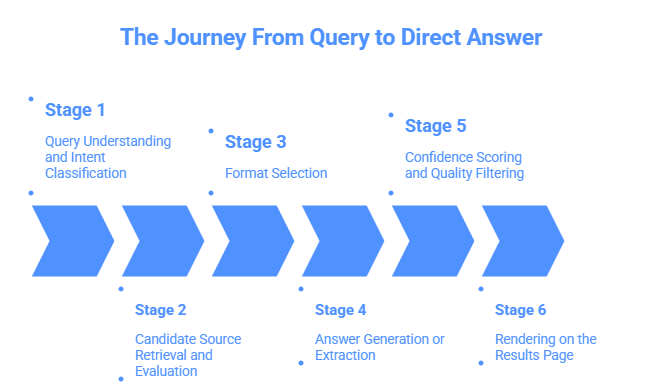
Stage 1: Query Understanding
Google's NLP systems analyze the query to classify user intent (informational, navigational, transactional). Only informational queries with a definable answer proceed down the direct answer pipeline.
Stage 2: Source Retrieval
Google scans its index for pages that don't just cover the topic, but contain content that clearly and directly answers the specific question asked.
Stage 3: Format Selection
Based on query complexity and content type, Google chooses the best format: Featured Snippet, AI Overview, Knowledge Panel, or People Also Ask.
Stage 4: Answer Generation
This stage differs by format. Featured Snippets extract text verbatim, while AI Overviews use the Gemini model to generate a new, original summary from source pages.
Stage 5: Quality Filtering
A confidence score is applied. For high-risk topics (medical, financial), Google applies extra scrutiny and may opt not to show a direct answer to prevent misinformation.
Stage 6: Rendering
The direct answer and organic results are assembled and delivered to the user's browser simultaneously, with the direct answer in the most prominent position.
How Google Decides Format in Real Time
Format selection isn't static; it's re-evaluated for every query based on several dynamic factors.
Content Changes: An update to a source page can cause Google to switch to a competitor's page that now provides a clearer answer.
Query Phrasing: 'What is content marketing' might trigger an AI Overview, while 'define content marketing' might trigger a Featured Snippet.
Freshness Requirements: For time-sensitive topics, Google prioritizes the most recently published high-quality content for its direct answers.
Personalisation: Search history and location can influence which sources are prioritized and what local information is displayed.
Visual Impact: SERP Layout With and Without Direct Answers
The presence of a direct answer significantly alters the architecture of a Google results page, impacting the visibility of organic results.
Without a Direct Answer
The organic results list begins immediately after any paid ads. The first organic result is highly visible, with 3-4 results typically appearing above the fold on desktop.
With a Direct Answer
AI Overview: Occupies the entire space
above organic results, often pushing the first organic link several screen-lengths down
the page, especially on mobile.
Featured Snippet: Less severe
displacement. The snippet box takes the space of 1-2 organic results, but the top
organic links often remain visible without scrolling.
Dynamic and Interactive Behavior
Direct answers are not static elements. They are designed to be interactive, encouraging further engagement on the results page.
- AI Overview Collapsing/Expanding: Users can expand the source citation panel or collapse the entire AI Overview to view organic results more easily.
- People Also Ask (PAA) Expansion: Clicking on one PAA question reveals the answer and dynamically loads several more related questions, creating a cascading exploration path.
- Rich Result Accordions: FAQ rich results within an organic listing expand inline, providing answers without navigating away from the SERP.
Contextual Factors: Location, Device, and Language
The direct answers a user sees are tailored to their specific context.
Location: Queries with local intent (e.g., 'restaurants near me') trigger answers with locally specific information like opening hours and addresses.
Device Type: Answers are formatted for the device. Voice assistants read them aloud, smart displays show visual cards, and mobile browsers show vertically stacked versions.
Language and Region: The availability and richness of direct answers are highest for widely supported languages with large pools of indexed content, like English.
The Multi-Format SERP: When Direct Answers Coexist
Google often displays multiple direct answer formats on the same results page. A query for a brand might show a Knowledge Panel, an AI Overview, and a People Also Ask section simultaneously. Each format serves a different dimension of user intent.
While AI Overviews and Featured Snippets are typically mutually exclusive for the top position, they can coexist with PAA boxes and rich results, creating a dense, multi-surface results page.
Frequently Asked Questions
Every direct answer is the outcome of a system asking one question: which source gives this user the clearest, most trustworthy, and most complete answer available?