How Do Direct Answers Increase Brand Visibility in Search?
"A brand that appears in direct answers does not just get seen. It gets seen first, at the moment a user has actively asked a question and that timing changes the entire nature of the visibility."
Brand visibility in search has always been about appearing when someone searches for something relevant to your business. Direct answers take that principle and intensify it at every level. They place the brand earlier in the results page, at higher attention positions, across more query types, and in more platforms than organic rankings alone can reach. Understanding precisely how that visibility increase works and across which stages of the customer journey it operates is the foundation of any brand strategy built for search in 2026.
TL;DR:
How Direct Answers Expand a Brand's Share of Voice in Search
Share of voice in search refers to the proportion of available visibility a brand captures across the queries relevant to its topic area. Organic rankings contribute to share of voice through position-based visibility a higher position means more exposure on more searches. Direct answers expand share of voice through a fundamentally different mechanism: they create additional visibility surfaces above the organic results that organic rankings cannot access.
A brand that holds the organic position one result for a query captures a share of the attention given to that result. A brand that also holds the direct answer position for the same query captures additional attention above that result, in a position that receives disproportionate focus from every user who sees it. The two positions are additive earning both simultaneously does not eliminate one in favour of the other. They contribute to share of voice independently.
The share of voice expansion becomes more significant when a brand holds direct answer positions across multiple queries simultaneously. A brand cited as the direct answer source on ten separate queries in its topic area is present at the top of the results page for ten different searches, each conducted by a different user with a different but related information need. The cumulative brand exposure across that range of queries far exceeds what any single high-ranking page can deliver. Direct answers are a share-of-voice multiplier, not a single visibility event.
Brand Visibility at Every Stage of the Customer Journey
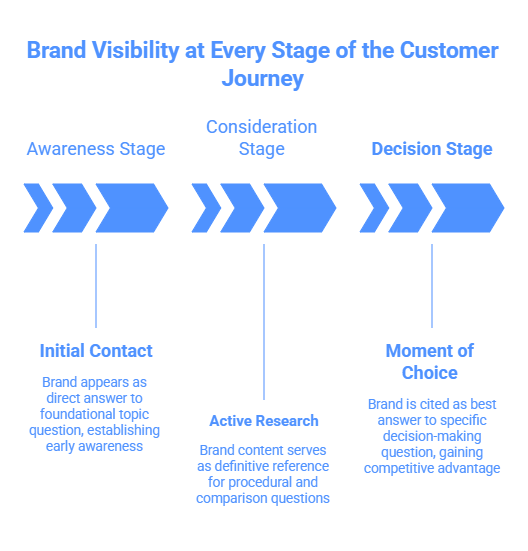
The customer journey from initial awareness to purchase decision involves multiple distinct stages, each characterised by different types of search behaviour. Direct answers are uniquely positioned to deliver brand visibility at every stage of that journey including stages where traditional search visibility is weakest.
Awareness Stage: Visibility Before the Brand Is Known
In the awareness stage, users are searching for information about a topic without yet having a brand preference or even awareness of specific brands in the space. They ask definitional questions, background questions, and exploratory questions. These are the query types that most consistently trigger direct answers and they represent the earliest possible moment at which a brand can enter a user's awareness through search.
A user who searches what is content marketing and sees a specific brand cited as the direct answer source for that foundational question encounters that brand name at the very beginning of their journey into the topic. They have formed no prior associations, made no comparisons, and built no loyalty elsewhere. The brand appears attributed, credited, and implicitly endorsed by Google before any competitor has had the opportunity to establish a presence in that user's mind.
This awareness-stage visibility is the dimension of direct answer brand impact most consistently undervalued in marketing measurement. It produces no click, no session, no conversion event and therefore no record in standard web analytics. But it plants the brand name at the point of first contact with a topic, which shapes every subsequent search, comparison, and decision that follows.
Consideration Stage: Visibility During Active Research
In the consideration stage, users know what they are looking for and are actively comparing options, evaluating approaches, and researching specifics. They ask how-to questions, comparison questions, and process questions. These query types also generate direct answers procedural answers, comparison answers, and list-format answers that surface the brand's content as the definitive reference on the topic being researched.
Brand visibility during active research carries a different quality from awareness-stage visibility. The user is engaged, their attention is focused, and they are forming judgments about sources that will influence their eventual decision. A brand whose content appears as the direct answer to the research question being asked at this moment is not simply seen it is consulted. The brand is positioned as the knowledgeable source the user turned to when they needed guidance. That positioning is qualitatively different from appearing in a list of links the user scrolls past.
Decision Stage: Visibility at the Moment of Choice
In the decision stage, users are comparing specific options, checking specific details, and seeking validation for a choice they are close to making. They ask questions like what is the best X for Y, how does X compare to Z, and what are users saying about X. Direct answers at this stage surface the brand's content in response to the precise question the user is asking immediately before a decision.
Decision-stage direct answer visibility is the most commercially significant of the three stages, because the user is at maximum purchase readiness when the brand appears. A brand that is present as a direct answer source at the decision stage cited by Google as the best answer to the question a user asks just before they choose has a competitive advantage that no amount of organic ranking below the direct answer position can replicate at that moment.
The Compounding Frequency Effect of Repeated Direct Answer Appearances
Brand visibility in direct answers is not a single exposure event. Users conducting research across a topic area ask multiple related questions a sequence of queries that collectively represent their information-gathering process. When a brand appears as the direct answer source across several of those sequential queries, the cumulative effect on brand perception compounds in a way that a single high-ranking page cannot produce.
A user who encounters the same brand cited as the direct answer to their first question, their third question, and their fifth question during a research session is receiving a repeated, consistent signal that this brand is the authoritative source on the topic. Each appearance reinforces the previous one. The brand is not just present in the results it is pervasive across the research journey. That pervasiveness translates into brand recall, trust formation, and a competitive advantage that is difficult for a brand appearing only once or twice to overcome.
This compounding effect is the reason that direct answer strategies should target clusters of related queries rather than single high-value queries in isolation. Winning one direct answer position creates a single brand impression. Winning five related direct answer positions across the same topic cluster creates a brand presence that follows the user through their entire research process and that level of presence shapes the eventual decision in ways a single impression cannot.
The Dark Funnel: Direct Answer Brand Visibility That Never Appears in Analytics
Standard web analytics platforms Google Analytics, Adobe Analytics, and their equivalents measure brand visibility through sessions, pageviews, and traffic sources. They record what happens when a user clicks through to a website. They cannot record what happens when a user sees a brand cited in a direct answer and does not click.
This unmeasured visibility encounters with the brand that occur in the results page without producing a click represents a significant portion of the total brand exposure that direct answers generate. A user who reads a direct answer sourced from a brand's content, registers the brand name, and moves on without clicking has still received a brand impression. That impression influences their future search behaviour, their eventual click decisions, and their perception of the brand's authority on the topic. None of this appears in any analytics report.
Marketing practitioners refer to this unmeasured influence as the dark funnel the portion of the buying journey that occurs in channels and moments that standard measurement tools cannot track. Direct answers are one of the most significant contributors to dark funnel brand influence in search, because they deliver the brand name and an implicit credibility endorsement to every user who sees them, regardless of whether any subsequent click occurs.
The practical implication for brand strategy is that the value of direct answer visibility cannot be evaluated solely through referral traffic metrics. A direct answer position that generates few clicks but thousands of impressions is delivering brand exposure at scale. Measurement approaches that capture impression data Google Search Console impression reports, brand search volume trends over time, and direct type-in traffic patterns provide a more complete picture of direct answer brand impact than click-based metrics alone.
How Direct Answers Displace Competitor Brand Visibility
Direct answer brand visibility is not only additive for the brand that earns the position. It is simultaneously subtractive for the brands that do not. When one brand's content occupies the direct answer position for a query, every competing brand is displaced from that position for every user who asks that question. The displacement is not partial the direct answer position is occupied by one source. All other brands are absent from it.
Owning the Definition of a Category
The brand whose content defines a category or explains a concept in the direct answer position effectively owns the user's initial understanding of that category. When a user asks what is marketing automation and a specific brand's definition is the direct answer, that brand's framing of the concept its terminology, its emphasis, its perspective is the lens through which the user first understands the topic. Competitors whose definitions do not appear in the direct answer are excluded from that formative moment.
This definitional ownership is a long-term brand positioning advantage that goes beyond single search events. Users who learn a concept through one brand's framing tend to describe and search for that concept using the vocabulary of the brand that defined it for them. Each time they do, they are more likely to encounter that brand again a self-reinforcing visibility loop that originates in the direct answer moment.
Blocking Competitor Entry Points
Every direct answer position a brand holds is a query entry point that is unavailable to competitors. A competitor brand whose content could potentially appear in the direct answer for a query, but does not because an incumbent brand's content is stronger, is excluded from the most visible position on the results page for that query. The competitor's organic results may still appear below the direct answer, but they appear in a context where the user has already received an answer from a competing brand.
The cumulative effect of holding multiple direct answer positions across a topic cluster is a defensive perimeter around the brand's territory in search. Competitors must either invest significantly to displace existing direct answers which requires producing measurably better-structured, more credible, and more precise content or accept permanent exclusion from the most prominent positions on the results page for those queries.
Multi-Platform Brand Visibility Through Direct Answers
Direct answer brand visibility in 2026 extends across platforms far beyond Google Search. The same content that earns a direct answer in Google results can generate brand visibility through voice assistants, AI platforms, and third-party search integrations each representing a separate audience and a separate opportunity for brand exposure.
Voice Assistant Brand Mentions
When a voice assistant reads a direct answer aloud, it typically identifies the source the brand whose content provided the answer by name. A user who asks their smart speaker a question and hears the answer attributed to a specific brand receives a brand impression through an audio channel, in a domestic or in-car environment, without any screen interaction. This audio brand impression is qualitatively different from a visual search result it is received in a more relaxed, less distracted context and may be more memorably retained than a brand name scanned in a list of results.
Voice assistant attribution of direct answers is a brand visibility channel that most brands have not yet measured or systematically optimised for. The queries that trigger voice answers conversational, question-format, natural language queries are precisely the queries that informational direct answer content is designed to address. Brands that hold direct answer positions for these queries are receiving audio brand mentions at scale across every voice-enabled device that searches their topic area.
AI Platform Citation Visibility
AI platforms Perplexity, ChatGPT with browsing, Microsoft Copilot, and their equivalents cite sources when they generate answers from web content. A brand whose content is selected as a source by these platforms receives a clickable citation alongside the AI-generated answer, presenting the brand name and a link to every user who reads that answer. This citation visibility is a direct extension of the brand exposure generated by direct answer positions in traditional search the same content quality and authority signals that earn direct answers in Google also make content more likely to be cited in AI platform answers.
The brand visibility value of AI platform citations differs from Google direct answer visibility in one significant way: AI platforms tend to attract users who are conducting deeper, more deliberate research than the average Google search user. A brand citation in a Perplexity answer is typically seen by a user who is actively investigating a topic, reading the full answer, and evaluating the sources listed. This engaged, research-oriented audience represents higher-quality brand exposure per impression than a quick Google result page scan.
How to Measure Direct Answer Brand Visibility
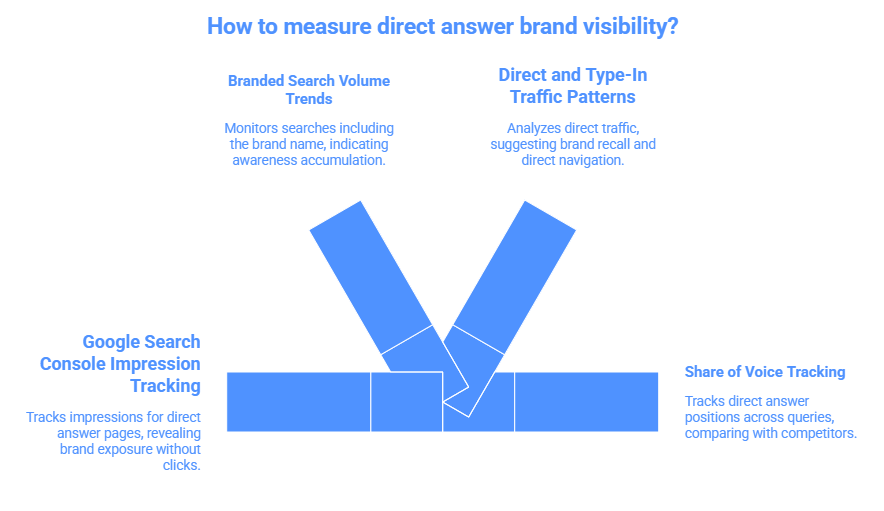
Measuring the brand visibility generated by direct answers requires a broader set of metrics than standard web analytics provides. The following measurement approaches give the most complete picture of direct answer brand impact.
Google Search Console Impression Tracking
Google Search Console reports impressions the number of times a page appeared in search results separately from clicks. A page that holds a direct answer position accumulates impressions for every search of the relevant query, regardless of whether any click occurs. Tracking impression volume for pages that hold direct answer positions over time reveals the scale of brand exposure those positions are generating. Comparing impression-to-click ratios for direct answer pages against standard organic result pages shows the proportion of brand exposure that is occurring without a click the volume of dark funnel brand impressions the direct answer is producing.
Branded Search Volume Trends
Branded search volume the number of searches including the brand name is a lagging indicator of brand awareness accumulation. A brand that earns significant direct answer visibility across a topic area over an extended period should see a gradual increase in branded search volume as more users who encountered the brand in direct answers return to search for it by name. Monitoring branded search volume through Google Search Console or third-party keyword tools over the months following a direct answer acquisition strategy provides an indirect measure of the awareness impact those positions are generating.
Direct and Type-In Traffic Patterns
Direct traffic visitors who type the brand's URL directly into a browser or arrive through bookmarks is another lagging indicator of brand recall built through search exposure. Users who encountered the brand in direct answers and formed a positive impression may return to the site directly without conducting a new search. A sustained increase in direct traffic that correlates with a period of significant direct answer position acquisition suggests that the brand exposure generated by those positions is translating into brand recall strong enough to drive direct navigation.
Share of Voice Tracking Across Target Queries
Purpose-built SEO and AEO monitoring tools can track which source holds the direct answer position for a defined set of target queries over time. Tracking this data across a topic cluster gives a direct measure of the brand's share of direct answer voice the proportion of the most visible positions in the results that the brand owns at any given moment. Comparing this share against competitor brands in the same topic area reveals the competitive brand visibility landscape and identifies the positions where competitor displacement is most achievable or most urgent to defend.
Building a Brand Visibility Strategy Around Direct Answers
A brand visibility strategy built around direct answers differs from a standard content or SEO strategy in its orientation. It is organised around the queries the target audience asks at every stage of their journey with the topic not just the queries most likely to drive clicks or conversions. The goal is to be the cited source for the questions that matter at every point of contact between the audience and the topic area.
- Map the full query journey for your target audience across awareness, consideration, and decision stages. Identify the questions asked at each stage and determine which already trigger direct answers when searched.
- Prioritise topic clusters over single queries. Build content that covers every major question in a topic area rather than targeting isolated high-volume queries. Cluster coverage multiplies direct answer presence and compounds brand exposure frequency.
- Track direct answer positions for all target queries weekly. Brand visibility through direct answers can change without affecting organic rankings. Monitoring the direct answer layer separately from the organic layer gives an accurate picture of brand presence at the most prominent positions.
- Treat impression data as a primary brand metric. Clicks tell you who visited. Impressions tell you who saw the brand. For direct answer brand visibility, impressions are the more relevant metric because a significant portion of brand exposure occurs without a click.
- Expand beyond Google intentionally. Identify the AI platforms and voice assistants most used by your target audience and ensure your direct answer content meets the specific requirements of each platform. Brand visibility across multiple answer surfaces compounds the total exposure the content generates.
- Monitor branded search volume as a lagging indicator of direct answer brand impact. Growth in branded searches following a period of direct answer acquisition is evidence that awareness-stage visibility is translating into brand recall.
Frequently Asked Questions
Final Thoughts
Direct answers increase brand visibility in search through mechanisms that standard marketing measurement was not designed to capture. They place the brand at the top of the results page before any competitor. They appear at every stage of the customer journey from first awareness to final decision. They compound across clusters of related queries to create a brand presence that follows users through their research. They generate brand impressions that never produce clicks but shape perception, recall, and eventual choice in the dark funnel. And they operate simultaneously across Google, voice assistants, and AI platforms.
The brands that will dominate search visibility in the years ahead are not necessarily those with the largest advertising budgets or the most organic links. They are the brands that understand the direct answer layer as a distinct brand channel one that operates above the organic results, rewards expertise and content precision, and delivers brand impressions at the moment of maximum user attention and trust.
Build for that layer deliberately. Map the queries your audience asks. Win the direct answer positions that matter most at each stage of their journey. Measure what those positions are actually doing not just in clicks, but in impressions, in brand recall, and in the competitive territory they defend against everyone else in your space.
Visibility in a list is visibility among options. Visibility in a direct answer is visibility as the answer. Build content that earns the second kind.