How Does Google Decide Which Website Gets the Direct Answer?
TL;DR:
"Google does not hand the direct answer position to the cleverest writer or the biggest website. It hands it to the source it trusts most to give its users a correct, safe, and reliable answer and trust is built at every level of a website, not just on a single page."
Most conversations about direct answer selection focus on page-level factors how clearly the answer is written, how the heading is phrased, how the list is formatted. Those things matter enormously. But Google's decision about which website earns a direct answer goes deeper. It evaluates the entire website behind the page its technical health, its content consistency, its real-world brand presence, its history with Google's systems, and whether the site as a whole is the kind of source Google is willing to put its name next to by surfacing it above every other result. This article covers those website-level decision criteria in full.
Google Evaluates Two Things Simultaneously: The Page and the Website
When Google selects a direct answer source, it runs two parallel evaluations. The first is at the page level is this specific page's content extractable, precise, and formatted correctly for the query? The second is at the website level is the site hosting this page a source Google is confident enough in to display above all other results to every user who asks this question?
A page can pass the first evaluation perfectly and still fail the second. Strong content on a website that Google does not consider sufficiently trustworthy, technically reliable, or editorially consistent will not earn a direct answer position regardless of how well that individual page is written. The website is the credential behind the page. Google checks the credential before it awards the position.
Understanding this two-level evaluation changes how you approach direct answer strategy. Optimising individual pages is necessary but not sufficient. The website behind those pages needs to meet a standard that makes Google comfortable placing it at the very top of the results hierarchy, in a position of implicit endorsement, every time a relevant query is asked.
How Google Builds Trust in a Website Over Time
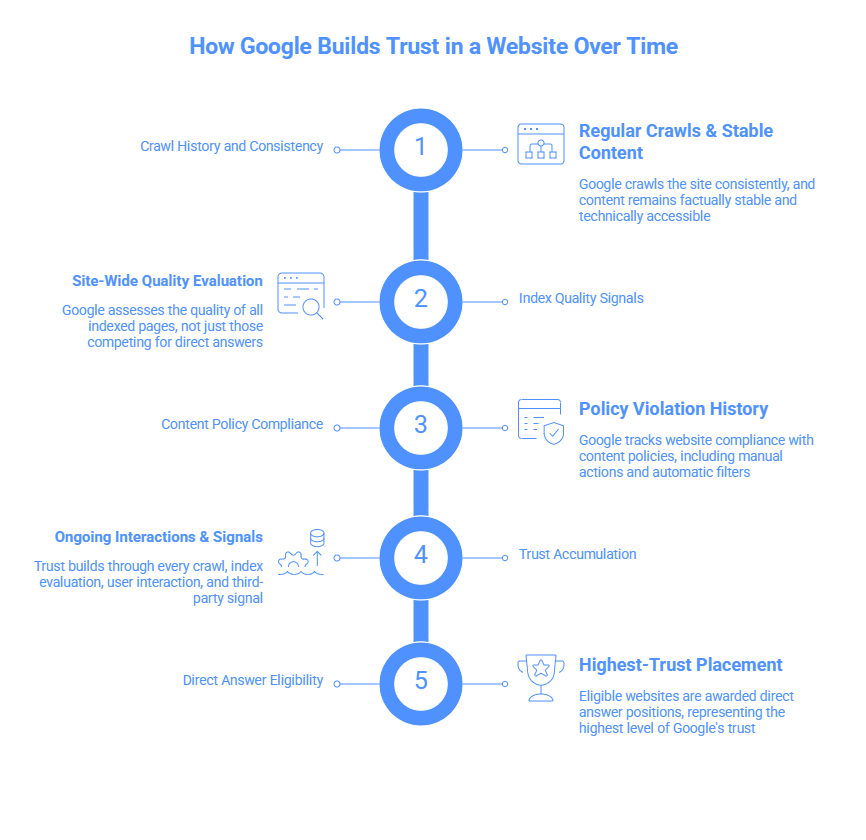
Google does not assess website trust in a single pass. Trust accumulates through a history of interactions between Google's systems and the website every crawl, every index evaluation, every user interaction with search results, and every signal arriving from third-party sources about the site's reputation. The trust level Google assigns to a website at any moment is the product of that accumulated history.
Crawl History and Consistency
Google's trust in a website begins with how reliably and consistently the site has behaved across every crawl. A website that has been crawled regularly over an extended period, whose content has remained factually stable and not been dramatically altered in ways that introduce errors, and whose technical structure has remained accessible and consistent, accumulates a crawl history that works in its favour.
Websites with irregular crawl histories due to server downtime, robots.txt misconfigurations that blocked crawlers, or frequent large-scale content overhauls have less stable trust profiles. Google's systems are more cautious about surfacing content from sites whose behaviour has been inconsistent, because inconsistency at the crawl level raises uncertainty about what the site will look like after the direct answer has been awarded.
Index Quality Signals Across the Whole Site
Google evaluates the quality of a website's indexed content as a whole, not only the pages competing for direct answer positions. A site where the majority of indexed pages are thin, low-value, or poorly structured sends a quality signal about the site as a whole that depresses the trust level applied to every page on that site including the pages that are individually well-written and well-structured.
This is the reason that large-scale content quality improvements across an entire site removing thin pages, consolidating duplicate content, improving the depth and accuracy of weaker articles can unlock direct answer positions on strong individual pages that were previously blocked by the site's overall quality profile. The strong page cannot outperform the site it sits on.
Content Policy Compliance History
Google maintains a history of whether a website's content has violated its content policies guidelines governing accuracy, safety, deceptive practices, spam, and harmful content. Websites that have previously received manual actions from Google's quality reviewers, or whose content has been automatically filtered for policy violations, carry that history into every subsequent evaluation.
A website that has resolved a past manual action and maintained clean content since then can rebuild its trust profile over time. But the rebuild is not instantaneous. Google's systems apply appropriate caution to sites with a policy compliance history, and direct answer positions which represent the highest-trust placement in the results are among the last to be awarded as trust is being restored.
Technical Website Health as a Direct Answer Eligibility Signal
The technical health of a website is a trust signal that operates at the site level and affects every page's eligibility for direct answer selection. Google uses technical health signals to assess whether a website is professionally maintained, user-focused, and stable enough to be reliably surfaced in a prominent position.
HTTPS and Security
HTTPS the encrypted version of HTTP is a baseline requirement for any serious direct answer eligibility. Websites still serving content over HTTP signal either negligence or lack of technical investment, neither of which aligns with the standard of trustworthiness Google requires from direct answer sources. Every page on a direct-answer-eligible website should be served over HTTPS with a valid, current SSL certificate. Mixed-content issues pages that load over HTTPS but reference resources served over HTTP are treated as partial security failures and should be resolved.
Core Web Vitals
Core Web Vitals are Google's standardised measurements of a webpage's loading performance, visual stability, and interactivity. They are assessed across the entire website, not just individual pages, and they feed into Google's overall assessment of whether the site delivers a reliable user experience.
Largest Contentful Paint measures how quickly the main content of a page loads. Interaction to Next Paint measures how responsive the page is to user input. Cumulative Layout Shift measures how stable the page layout is as it loads whether elements jump around unexpectedly as the page renders. Websites that score in the good range across all three metrics present as well-maintained, user-focused properties. Websites with poor Core Web Vitals scores signal that the user experience has not been invested in, which reduces Google's confidence in surfacing them prominently.
Mobile Usability
Google indexes and evaluates websites primarily through their mobile versions. A website that delivers a poor mobile experience through small text, content wider than the screen, elements too close together to tap accurately, or content that requires horizontal scrolling is assessed as less user-friendly than its mobile-optimised competitors. Since the majority of search queries are now submitted from mobile devices, a website that does not serve mobile users well is not serving the majority of Google's users well, which directly affects its eligibility for the highest-prominence positions in the results.
Crawlability and Indexability
A website must be fully accessible to Google's crawlers for all of its pages to be evaluated as direct answer candidates. Crawl errors pages returning 404 or 500 status codes reduce the coherence of the site's indexed content. Incorrectly configured noindex directives that accidentally block important pages from the index remove those pages from consideration entirely. Slow server response times that time out Google's crawl requests result in incomplete indexing.
Maintaining a clean, error-free crawl environment signals to Google that the website is actively maintained and that its content can be reliably accessed and evaluated. A sitemap submitted through Google Search Console and kept current with the site's actual content structure provides Google with an explicit map of the site's pages, accelerates crawling of new and updated content, and reduces the likelihood of important pages being missed in regular crawl cycles.
Brand Signals and Entity Recognition Across the Web
Google does not evaluate a website in isolation. It cross-references what it knows about the site with what the broader web says about the entity behind it. A website that is recognised as the online home of a known, credible, real-world entity a business, an organisation, an established publication, a recognised expert receives a level of trust from Google that a site with no identifiable real-world presence cannot match.
Named Entity Status
Google's Knowledge Graph its structured database of known entities plays a role in direct answer selection that goes beyond the knowledge panel format. When Google recognises a website as associated with a named entity it has verified data on, it extends the credibility of that entity to the website's content. A healthcare advice website operated by a named medical institution Google has an established knowledge graph entry for is evaluated differently from an anonymous health blog with no traceable real-world affiliation.
Building named entity status requires consistent, accurate information about the organisation or individual behind the website across authoritative third-party sources Wikipedia, Companies House records, professional association directories, industry databases, and verified social media profiles. The more consistently this information appears across credible external sources, the stronger the entity signal Google assigns to the website.
Third-Party Brand Mentions and Citations
Brand mentions across the web references to the website or the organisation behind it in news articles, industry publications, academic papers, professional forums, and authoritative directories function as third-party credibility endorsements. They tell Google that external sources consider this website a credible reference, independently of whatever the website says about itself.
These unlinked brand mentions carry trust value even when they do not include a hyperlink. Google's systems are capable of recognising mentions of a brand or website name in text and associating that mention with the entity's trust profile. A website that is cited, referenced, or recommended across a broad range of credible external sources has a stronger brand signal than one whose only web presence is its own domain.
Consistency of Identity Across All Platforms
Google cross-references the identity information a website presents about itself its name, address, phone number, category, founding date, and key personnel against the same information appearing on external platforms. Inconsistencies between what a website says about itself and what authoritative external sources record about it introduce uncertainty into the trust evaluation.
A business whose name appears in three different forms across its website, its Google Business Profile, its LinkedIn page, and its industry directory listings creates ambiguity about which entity the website represents. A business whose identity information is consistent, accurate, and identical across every platform it appears on presents as a more clearly defined and reliably identifiable entity one that Google's systems can evaluate with confidence.
Editorial Standards and Content Consistency Across the Site
Google's Quality Rater Guidelines the documented framework used by human evaluators who assess the quality of search results place significant weight on the editorial standards a website demonstrates across its published content. These guidelines inform the machine learning systems that score websites for direct answer eligibility.
Who Is Responsible for the Content
Websites that clearly identify who produces their content named authors with verifiable credentials, an editorial team with a stated review process, an organisation with a documented content policy are assessed more favourably than websites where content appears without clear authorship or editorial accountability. For direct answer purposes, the question Google is asking is: if this answer turns out to be wrong, is there a real, identifiable person or organisation responsible for it?
Displaying author credentials prominently, linking to author profiles that demonstrate relevant expertise, maintaining an accessible About page that describes the organisation and its editorial approach, and publishing a clear corrections policy all contribute to the editorial accountability signals that Google uses to assess a site's fitness for direct answer selection.
Topical Consistency and Depth
Websites that publish consistently on a defined set of topics over an extended period build topical authority in that subject area. Google assesses a website's topical coverage as part of its eligibility evaluation a site that has published extensively on a subject, covered it from multiple angles, and maintained that coverage consistently is considered a more authoritative source on that subject than a site that publishes on the same topic occasionally among many unrelated subjects.
For direct answer selection on a specific topic, a website with deep, consistent, longstanding coverage of that topic area outperforms a generalist site of equal or higher overall authority that covers the topic shallowly. Specialisation is rewarded at the website level, not just at the page level.
Absence of Content That Violates Trust
Google's assessment of a website's fitness for direct answer selection includes an evaluation of whether the site publishes content that would undermine user trust in the answer being surfaced. Websites that mix trustworthy informational content with deceptive advertising, misleading headlines, unsubstantiated health claims, or sensationalised content create an inconsistent trust environment that lowers the overall confidence score Google applies to the site.
A website where every published page meets the same standard of accuracy, transparency, and editorial responsibility presents a consistent trust profile. A website where strong content coexists with low-quality or policy-violating content presents an inconsistent profile that reduces the trust extended to even its best individual pages.
How Google Chooses When Multiple Websites Are Eligible
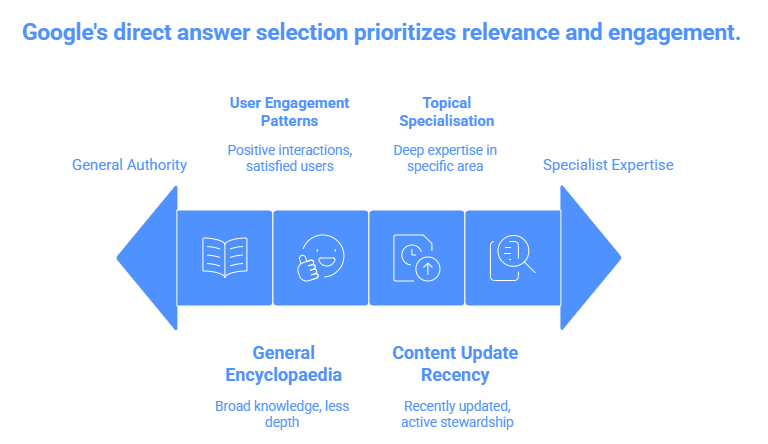
For many queries, several websites meet the baseline trust and content quality criteria for direct answer selection. When Google's systems have identified multiple eligible candidates, the final selection comes down to a comparison across the remaining differentiating factors.
Topical Specialisation Over General Authority
When a specialist website and a general authority website are both eligible for a direct answer on a topic that falls within the specialist's focus area, the specialist consistently wins. Google's systems assess topical relevance depth as a differentiator a medical information website citing qualified physicians on a health query outperforms a general encyclopaedia with high overall authority on the same query, because the specialist's depth and demonstrated expertise on that specific subject is stronger.
Content Update Recency Relative to Competitors
When multiple eligible sites have similar quality profiles, the site whose relevant content was most recently reviewed and updated often wins the direct answer position for time-sensitive or evolving queries. Recency is a tiebreaker applied at the site comparison stage. A site that maintains a clear content review schedule with last-updated dates visible on relevant pages and regular refreshes of key content signals active editorial stewardship that competing sites without visible update practices cannot match.
User Engagement Patterns at the Domain Level
Google uses aggregated, anonymised user engagement data patterns across all users' interactions with a website's content in search results as one input in its site-level trust evaluation. A website whose pages, when clicked from search results, tend to result in users finding what they needed and not immediately returning to the search page presents a positive engagement profile. A website whose pages frequently result in users returning quickly to the search results suggesting the content did not satisfy the need presents a weaker engagement profile that reduces its competitiveness for prominent direct answer placements.
What Website Owners Can Do to Improve Direct Answer Eligibility
The website-level factors that determine direct answer eligibility are within the control of every site owner. They require sustained investment rather than one-time changes, but each improvement directly and measurably strengthens the site's eligibility profile.
- Conduct a full technical audit and resolve all crawl errors, HTTPS issues, Core Web Vitals failures, and mobile usability problems. These are baseline requirements, not optional extras.
- Establish clear authorship and editorial accountability across all published content. Named authors, visible credentials, an accessible About page, and a stated editorial process all signal that a real, responsible entity stands behind the content.
- Build and maintain consistent entity information across Google Business Profile, Wikipedia, Wikidata, LinkedIn, and all relevant third-party directories. Consistency of identity signals across external platforms reinforces your site's named entity status with Google.
- Invest in topical depth rather than breadth. A website that covers a defined subject area comprehensively and consistently over time builds stronger direct answer eligibility in that area than a site that covers many topics shallowly.
- Remove or substantially improve thin, low-quality indexed pages. The overall quality profile of a site's indexed content affects the trust extended to its best individual pages. Raising the floor of content quality across the site raises the ceiling for individual page eligibility.
- Earn third-party brand mentions and citations from credible industry sources, publications, and directories. External recognition of the website as a credible reference strengthens the brand signal Google uses in its site-level trust evaluation.
- Keep content updated visibly and systematically. Display last-reviewed dates on key pages, maintain a regular content review calendar, and prioritise freshness on topics where the answer evolves over time.
Frequently Asked Questions
Final Thoughts
Google's decision about which website earns the direct answer is not made on the merits of a single page alone. It is made on the totality of what the website behind that page represents its technical reliability, its editorial standards, its real-world brand presence, its topical depth, and its history of consistent, trustworthy behaviour across every interaction with Google's systems.
The websites that hold direct answer positions consistently are those that have built a site-level trust profile strong enough that Google is comfortable placing them above every other result, every time a relevant query is asked. That level of trust is not built by optimising one page. It is built by maintaining every dimension of the website to a standard that makes Google's decision to choose it the easiest possible one to make.
Audit the whole site. Fix the technical foundation. Establish editorial accountability. Build consistent entity signals. Develop topical depth. Earn external recognition. Maintain freshness. Do all of these things consistently and the direct answer positions above your competitors become a natural consequence rather than a goal still out of reach.
Google hands the direct answer to the website it trusts most. Build the kind of website that earns that trust at every level and the position will follow.