How to Optimize Content for Google AI Overviews
TL;DR:
Google AI Overviews are the highest-visibility real estate in search. Learn the strategy to get your business cited, earning consistent visibility before users even click a link. This guide explains exactly how.
Why Most Business Content Is Overlooked by AI
Traditional SEO content, focused on keywords and word counts, often fails to meet the specific needs of AI Overviews. Google's AI requires content that is instantly understandable and extractable. Pages with buried answers, vague language, or poor structure are passed over, creating a gap between ranking on page one and being cited. Closing this gap requires a new, intentional approach to content creation.
The Core Principles of AI Overview Selection
To optimize effectively, you must understand the principles driving Google's source selection. Every tactic is rooted in these fundamentals.
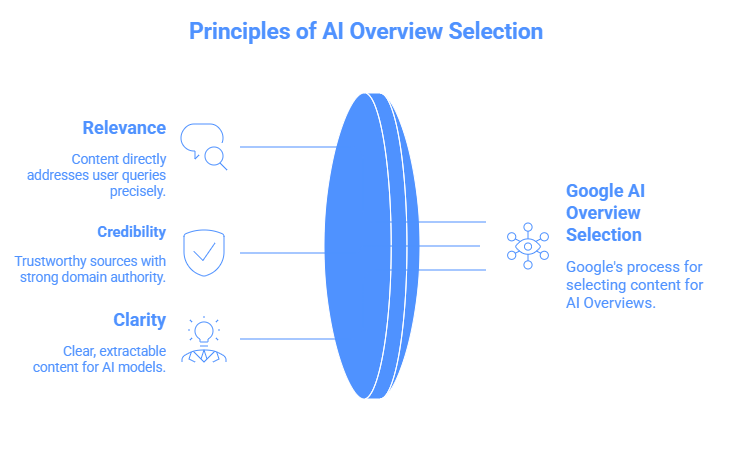
Relevance to the Query
Your content must directly and precisely answer the user's exact question. The closer the match between your answer and the user's intent, the higher your chance of selection.
Credibility & Trustworthiness
Google prioritizes sources it trusts. This is evaluated through domain authority, link quality, author expertise (E-E-A-T), and a history of publishing accurate information.
Clarity & Extractability
An AI model must be able to easily extract a clear answer. Content with a simple structure, clear headings, and direct answers is a technical requirement for eligibility.
Step-by-Step Guide to Optimizing for AI Overviews
Follow this actionable process to optimize your business content for Google AI Overview citations.
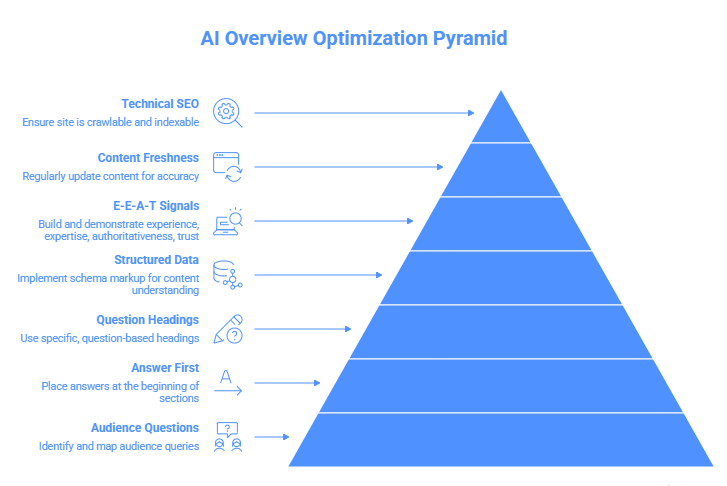
- Identify Audience Questions: Use tools like 'People Also Ask' to build a library of questions your audience asks. Each question is a content opportunity.
- Answer First, Explain Second: Place a clear, direct answer to the primary question within the first two sentences. This is the single most impactful change you can make.
- Use Question-Based Headings: Structure your content with H2s and H3s that mirror user queries (e.g., 'How Does X Work?' instead of 'Our Approach to X').
- Implement Structured Data: Use FAQ, How-To, and Article schema to give Google machine-readable information about your content, making extraction easier.
- Demonstrate E-E-A-T: Make your Experience, Expertise, Authoritativeness, and Trustworthiness visible with author bios, citations, and original research.
- Keep Content Fresh: Regularly update your key pages (at least every 3-6 months) to signal that your information is current and reliable.
- Solidify Technical SEO: Ensure your site is fast, crawlable, and mobile-friendly. Technical health is the foundation for all other AEO efforts.
Build Topical Authority for Sustained Visibility
While a single article can get cited, topical authority earns consistent citations across many queries. This means your website is the most comprehensive resource on a subject. To build it:
- Map out and create content for every subtopic in your niche.
- Interlink all related content pieces to show Google the connections.
- Publish consistently to demonstrate ongoing expertise and commitment.
Common Mistakes to Avoid
Avoiding these common pitfalls is as important as implementing the right strategies.
- Writing promotional copy instead of helpful, informative answers.
- Burying the main answer deep within long introductions.
- Ignoring schema markup and relying on content quality alone.
- Publishing content without clear author attribution and credentials.
- Targeting broad keywords instead of specific, question-based queries.
How to Measure Your AI Overview Performance
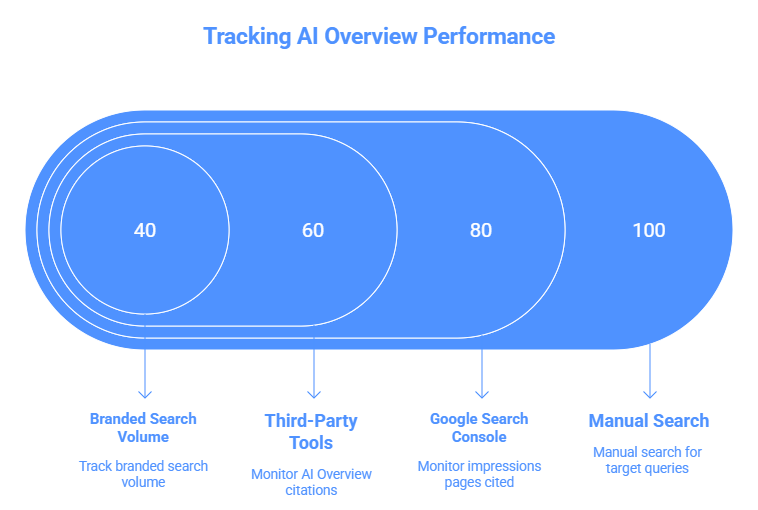
Tracking performance is key to refining your strategy. Use these methods to monitor your visibility.
- Manually search your target queries to see if your content is cited.
- Monitor Google Search Console for increased impressions without proportional clicks.
- Use third-party AEO tracking tools that specifically monitor AI Overview citations.
- Track branded search volume, which often increases with consistent citations.
Frequently Asked Questions
Final Thoughts: The Future of Search is Here
Google AI Overviews are the biggest shift in search visibility in years. The businesses that will dominate this new landscape are those that commit to writing with clarity, building with structure, and demonstrating true expertise. The position above position one is available, and it belongs to the businesses willing to earn it.