How Do I Write Content That Triggers Direct Answers in Google?
Most content fails to earn direct answers not because it is wrong but because it is not written in the way Google reads. The fix is not more research. It is a different way of constructing sentences, sections, and pages.
Learn HowContact UsWriting content that earns direct answer positions in Google is a distinct craft from writing content that ranks well organically. The skills overlap but the technique differs in ways that matter enormously at the page level. This article covers the exact writing methods from how you open a sentence to how you build an entire page that give your content the best possible chance of being selected as a direct answer.
The Answer-First Principle: Flip How You Write
Traditional content writing builds toward the answer. It opens with context, provides background, develops the argument, and delivers the key information somewhere in the body of the article. This structure works well for readers who are already engaged. It works poorly for Google's direct answer extraction system.
Direct answer writing works in the opposite direction. The answer comes first in the very first sentence beneath the relevant heading. The context, supporting detail, and elaboration follow after the answer has already been stated. Google extracts the opening of a section, not the conclusion. If your answer is at the end of a paragraph, it will not be extracted as a direct answer regardless of how clearly it is written.
Applying the answer-first principle in practice means retraining a writing habit. Before you write any section of a page, ask one question: if someone read only the first two sentences under this heading, would they have a complete and usable answer? If the answer is no, rewrite the opening until it is yes. Everything else on the page is supporting material. The direct answer candidate is always the first two sentences.
How to Write the Direct Answer Sentence Itself
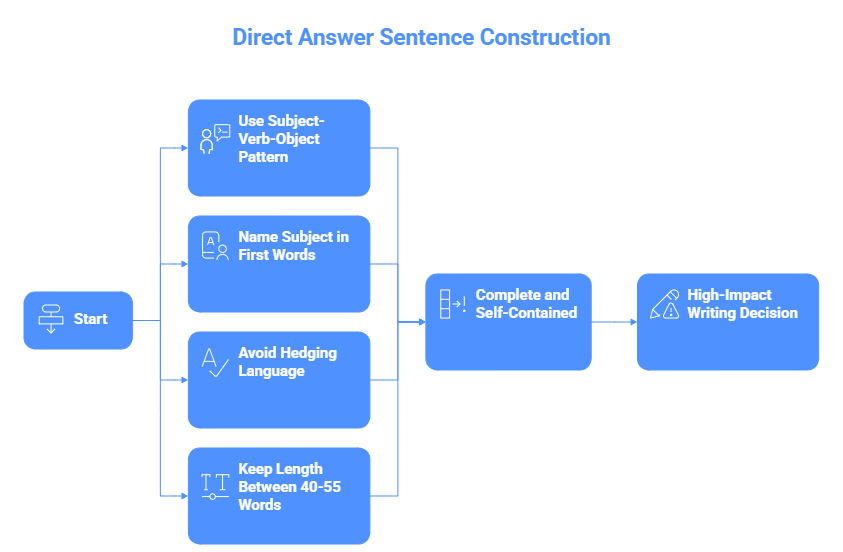
The direct answer sentence the single sentence Google is most likely to extract for a given query has a specific construction that maximises extraction probability. Getting this sentence right is the most high-impact writing decision on any page targeting a direct answer position.
Use the Subject-Verb-Object Pattern
The clearest direct answer sentences follow the simplest grammatical structure: subject, verb, object. They state what the thing is, does, or means in a single clause without subordinate phrases, qualifications, or dependent clauses that require surrounding text to make sense.
Weak opening: Although there are many ways to think about it, content marketing can generally be described as a strategic approach that involves creating and distributing valuable content.
Strong opening: Content marketing is a strategy of creating and distributing valuable content to attract and retain a defined audience. That sentence is complete, self-contained, and extractable. The weak version is not.
Name the Subject in the First Word or Two
Search engines match a direct answer sentence to a query partly by confirming that the subject of the sentence matches the subject of the query. Starting your direct answer sentence with the exact term the user searched for or its closest grammatical equivalent reinforces this match and increases extraction confidence.
If the query is what is photosynthesis, the ideal opening sentence begins with Photosynthesis is not It is, not The process is, not This refers to. The subject of the query should be the subject of the sentence.
Avoid Hedging Language in the Opening Sentence
Phrases like it is generally considered, many experts believe, some sources suggest, and it depends on the context all reduce extractability. They introduce ambiguity that makes the search engine less confident the sentence can stand alone as a reliable direct answer. Save hedging language for the explanatory paragraphs that follow the direct answer sentence. The opening sentence should state the answer without qualification.
Keep the Opening Answer Between 40 and 55 Words
The optimal length for a paragraph-format direct answer is between 40 and 55 words long enough to be complete, short enough to fit cleanly within the direct answer box without truncation. Sentences longer than this risk being cut off mid-thought. Sentences shorter than this may be judged incomplete. Count the words in your direct answer opening before publishing and adjust to fall within this range.
Writing Headings That Signal Google Directly
The heading above a direct answer candidate section is the primary signal Google uses to confirm that the content beneath it is relevant to a specific query. A heading that does not closely match the query phrasing creates friction in the extraction process and friction costs direct answer positions.
Write Headings as Questions
Question-format headings are the single most reliable heading structure for direct answer content. They mirror the exact format of the user's query, make the heading-to-answer relationship unambiguous, and tell Google precisely what question the content beneath is answering.
Compare these two headings covering identical content. First: Benefits of Regular Exercise. Second: What Are the Benefits of Regular Exercise? The first heading is a topic label. The second is a direct answer invitation. Google treats them very differently when scanning for direct answer candidates.
Match the Heading to the Query Word-for-Word Where Possible
When you know the exact phrasing of the query you are targeting from keyword research, from Google Search Console, from autocomplete suggestions use that exact phrasing in the heading. Do not paraphrase, reword for style, or replace key terms with synonyms. The closer the heading wording is to the query wording, the stronger the extraction signal.
This does not mean every heading must be mechanically identical to a search query. It means that for sections where a direct answer is the goal, heading creativity is a liability, not an asset. Save creative heading writing for sections where direct answer capture is not the objective.
Use One Question Per Heading
Headings that contain two questions, or a question followed by a related qualifier, split the search engine's interpretation of what the section is answering. Each heading should address exactly one question. If your content naturally covers two related questions in a single section, split them into two sections each with its own question-format heading and its own direct answer opening sentence.
Writing for Each Direct Answer Format
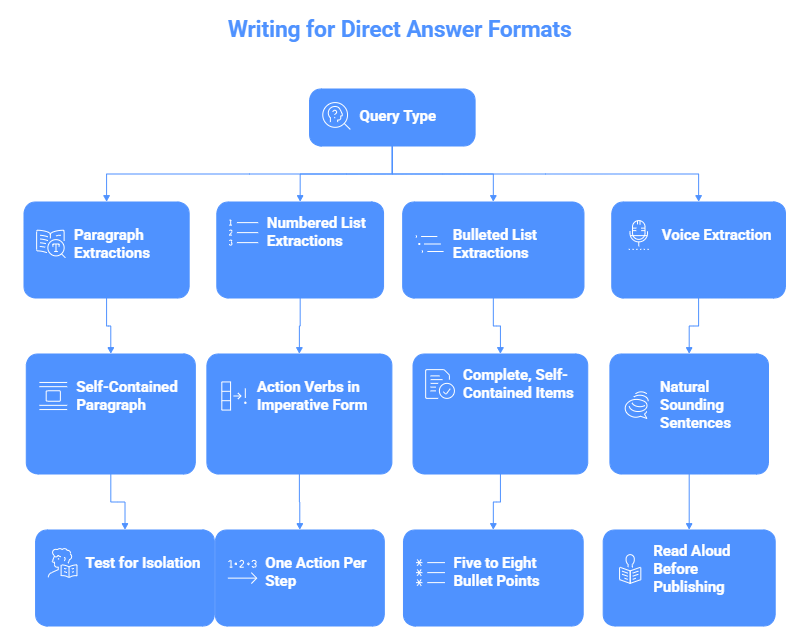
Different query types extract different content formats as direct answers. Writing the correct format for the query type you are targeting is as important as writing the answer clearly. A well-written paragraph answer to a procedural query will be passed over in favour of a list-formatted answer on the same topic.
Writing for Paragraph Extractions
Paragraph extractions are used for definitional, explanatory, and conceptual queries. The format requirement is a single, self-contained paragraph of two to four sentences that opens with the direct answer sentence, provides one or two sentences of necessary context, and stops. Do not continue into examples, exceptions, or elaboration within the extractable paragraph those belong in a separate paragraph below.
The extractable paragraph must make complete sense in isolation. Test it by reading it without any surrounding content. If it raises questions that the surrounding text answers, it is not yet extractable. Rewrite until it is fully self-contained.
Writing for Numbered List Extractions
Numbered list extractions are used for procedural, sequential, and step-based queries. Each step in the list must begin with an action verb in the imperative form do this, write that, open the file, click the button. Steps that begin with nouns, connectives, or passive constructions are weaker extraction candidates.
Keep each step to a single action. Multi-action steps open the settings and navigate to the privacy tab and click advanced are harder to extract cleanly and harder for users to follow. One action per step is the rule.
The list itself should appear immediately beneath the question-format heading with no introductory paragraph between the heading and the first list item. An introductory sentence before the list pushes the list down the page and reduces extraction probability for the list items.
Writing for Bulleted List Extractions
Bulleted list extractions are used for category, type, example, and benefit queries. Each bullet point must be a complete, self-contained item that makes sense without the surrounding bullets. A bullet point that reads Increased engagement is not extractable without context. A bullet point that reads Regular exercise increases cardiovascular endurance and reduces resting heart rate is extractable on its own.
Aim for five to eight bullet points per extractable list. Fewer than five may be judged incomplete for category queries. More than eight begins to lose coherence as a direct answer and reduces the likelihood that the full list is extracted. When the content naturally produces more than eight items, split the list across two sections with different question-format headings.
Writing for Voice Extraction
Voice extraction imposes an additional constraint on top of all other direct answer writing requirements: the answer must sound natural when read aloud. Sentences with complex clause structures, technical notation, parenthetical asides, or strings of figures and units are easily understood on screen but become confusing when spoken without visual formatting support.
For content where voice extraction is a goal, read every direct answer sentence aloud before publishing. If it sounds unnatural, awkward, or confusing without visual context, rewrite it. A voice-ready direct answer sentence is short, uses everyday vocabulary, contains no abbreviations that require expansion, and delivers its complete meaning in a single breath.
Page-Level Writing Decisions That Affect Direct Answer Selection
Individual sentences and headings are the micro-level of direct answer writing. The macro-level decisions about how a page is constructed as a whole also affect direct answer selection in ways that individual section optimisation cannot overcome.
One Primary Question Per Page
Pages built around a single primary question consistently outperform pages built around broad topics when competing for direct answers on specific queries. A page whose entire structure title, introduction, headings, and conclusion is organised around answering one question signals very clearly to Google what that page is about and which direct answer position it is competing for.
Broad topic pages scatter their direct answer signals across many potential queries without being the strongest candidate for any single one. A tight, focused page built around one question is a stronger direct answer candidate for that question than a broad page that covers it as one section among many.
The Introduction Must Not Be the Answer
A common mistake in direct answer writing is placing the answer in the article introduction and then repeating it in the relevant section further down the page. Google's extraction system evaluates sections individually. If the clearest statement of the answer is in the introduction under a non-question heading, it will not be extracted as reliably as the same answer under a question-format section heading lower on the page.
Write introductions that frame the question and establish context. Write the direct answer in the section specifically built for it, under the question-format heading that marks it as the answer location. The introduction and the direct answer section serve different purposes and should be written to serve those purposes separately.
Supporting Content Must Follow, Not Precede, the Answer
Everything that adds depth, context, examples, caveats, or elaboration to the direct answer belongs after the extractable section, not before it. When supporting content precedes the answer, it delays the answer and reduces the probability that Google identifies the correct extraction point. When it follows, it adds value for readers who want depth without disrupting the extraction signal for readers and search engines that need only the direct answer.
Internal Linking Reinforces Topical Authority
Direct answer selection is influenced by how the search engine assesses your overall authority on a topic, not just the quality of a single page. Internal linking connecting related pages on your site to each other through contextually relevant anchor text signals to the search engine that your content on a topic is deep, interconnected, and authoritative.
A page competing for a direct answer on a specific question is more likely to be selected when it sits within a web of related pages covering adjacent questions on the same topic. Each internal link from a related page reinforces the target page's topical relevance. Build content clusters around your direct answer target topics and link them deliberately.
The Content Audit and Rewrite Workflow
Most direct answer gains come not from new content but from rewriting existing content that already ranks but is not structured for extraction. A systematic audit and rewrite workflow applied to your highest-traffic ranking pages is the fastest route to direct answer positions.
- Step One: Identify Ranking Pages With Direct Answer Potential
Pull your top ranking pages from Google Search Console. Filter for pages receiving significant impressions on question-based queries. These are the pages already in contention for direct answer positions they are being seen for informational queries but not earning the direct answer because the content is not structured for extraction.
- Step Two: Check the Current Results Page for Each Target Query
For each question-based query driving impressions to a target page, search Google and observe what the results page currently shows. If a direct answer is already present from a competitor, study its structure the heading phrasing, the opening sentence length, the format. If no direct answer is present, the position is open and available for a well-structured page to claim.
- Step Three: Apply the Writing Framework to Each Target Section
For each target query, locate the section of the page that covers that question. Apply the full writing framework in order:
- Rewrite the heading as a question that matches the query phrasing exactly.
- Rewrite the opening sentence as a direct, subject-first answer of 40 to 55 words.
- Ensure the opening answer is self-contained remove any dependency on surrounding text.
- Match the format to the query type: paragraph for definitional, numbered list for procedural, bulleted list for category queries.
- Move all supporting detail, context, and elaboration to paragraphs after the direct answer section.
- Read the direct answer sentence aloud to test for voice extraction suitability.
- Step Four: Update and Resubmit
After completing the rewrites, update the page's last-modified date, save the changes, and submit the updated URL through Google Search Console for recrawling. This accelerates the process of Google re-evaluating the updated content for direct answer selection. Without a manual submission, recrawling may take weeks depending on your domain's crawl frequency.
- Step Five: Monitor and Iterate
Check the results page for each target query weekly in the two to four weeks following the rewrite. Direct answer selection changes can appear within days on high-authority domains or take several weeks on lower-authority sites. If the direct answer position has not been won within four weeks, revisit the structure of the direct answer section, compare it against the current winner if one exists, and refine the phrasing or format further.
Frequently Asked Questions
Final Thoughts
Writing content that triggers direct answers in Google is a learnable, repeatable craft. It requires a different instinct from traditional content writing one that leads with the answer rather than building toward it, that treats the heading as a query match rather than a topic label, and that formats every section for extraction rather than only for readability.
The pages that consistently earn direct answer positions are not always the longest, the most comprehensive, or the highest ranked. They are the pages whose writers made the right decisions at the sentence level decisions about where to put the answer, how to open the section, what format to use, and how to make the extraction as clean and unambiguous as possible.
Apply the answer-first principle. Write headings as questions. Match the format to the query type. Keep direct answer sections self-contained. Audit and rewrite your best-ranking pages before building new ones. The direct answer position above your competitors is not waiting for more content. It is waiting for better-constructed content.
The search engine does not reward effort. It rewards clarity. Write clearly enough that Google has no reason to choose anyone else.