What Is the Difference Between a Keyword and an Entity?
TL;DR:
The difference between a keyword and an entity is not a technicality. It is the difference between a strategy built for how search engines used to work and one built for how they work now. Every major development in search over the past decade the Knowledge Graph, natural language processing, AI-generated answers, voice search is built on entity understanding, not keyword matching. This article explains precisely what separates the two and why that separation changes how content should be planned and written.
'A keyword tells Google what words appear on your page. An entity tells Google what your page is actually about. One is a text signal. The other is a meaning signal. In AEO, meaning wins.'
What a Keyword Is
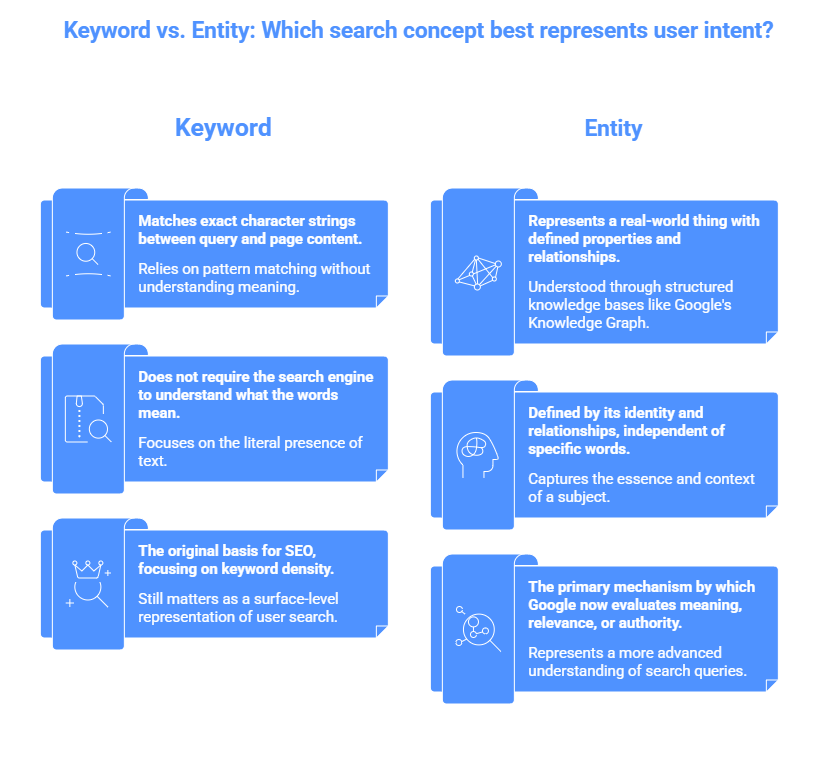
A keyword is a specific word or phrase that a user types into a search engine. It is a text string. Search engines originally operated by matching the characters in a query to the same characters appearing on indexed pages. A page that contained the keyword content marketing would be considered relevant to a query containing those same words.
Keyword-based search is pattern matching. It does not require the search engine to understand what the words mean. It requires only that the same string of characters appears in both the query and the page. This is why early SEO was built around keyword density repeating target phrases enough times that the pattern-matching engine would rate the page as highly relevant.
Keywords still exist and still matter in search. They are the surface-level representation of what a user is searching for. But they are no longer the primary mechanism by which Google evaluates meaning, relevance, or authority. That role now belongs to entities.
What an Entity Is
An entity is a distinct, uniquely identifiable thing that exists in the real world or in a defined knowledge domain. A person, a company, a city, a concept, a product, a historical event each is an entity. What defines an entity is not its name but its identity. It is a thing with defined properties, relationships to other things, and a recognised existence independent of the words used to refer to it.
Google understands entities through its Knowledge Graph a structured database of things and the relationships between them. In the Knowledge Graph, the entity content marketing is not defined by its two words. It is defined by what it is: a concept, a subtype of digital marketing, a practice involving content creation, related to audience building, associated with lead generation, and connected to organisations, tools, and practitioners in that space. All of that meaning exists at the entity level, independently of the specific words used in any given query.
The Core Difference: Text Match vs Meaning Match
How Keyword Matching Works
When a search engine processes a query through keyword matching, it looks for pages containing the same words. A query for best email marketing tools returns pages containing those specific words or close variations ranked by relevance and authority signals. A page about the same topic that uses the phrase top platforms for email campaigns may rank less well because its text matches the keyword less precisely, even though it covers the identical subject.
This is the fundamental limitation of keyword-based strategy. It ties visibility to specific word choices. Every synonym, every phrasing variation, every conversational way of asking the same question that does not use the target keyword is a missed opportunity. The content exists. The user wants it. But the text string does not match, so the connection is not made.
How Entity Matching Works
When Google processes a query through entity understanding, it identifies the entities the user is asking about and matches them to content that is associated with those entities regardless of the specific words used. A query for best tools for sending newsletters, top email automation platforms, and what software should I use for email marketing are all asking about the same entity cluster: email marketing software. Content strongly associated with that entity cluster is eligible for all three queries, not just the one that matches its exact keyword.
This is why entity association expands content eligibility far beyond keyword targeting. A page that Google recognises as being about the entity email marketing software is a candidate for every query about that entity in every phrasing, every language register, and every question format a user might choose. A page optimised only for a specific keyword phrase is a candidate only for queries containing those words.
Where Keywords Fail and Entities Succeed
Voice Search
Voice queries are conversational and rarely match keyword phrases. A user asking a voice assistant what is a good programme for managing email lists is not using the keyword email marketing software but they are asking about the same entity. Keyword-optimised content that has not been built with entity association will not surface for this query. Entity-associated content will, because the search engine connects the question to the relevant entity regardless of phrasing.
AI-Generated Answers
AI answer engines including Google's own systems do not retrieve pages by keyword match. They identify the entities relevant to the query, evaluate which sources have established authority on those entities, and synthesise answers from those sources. A brand that has built strong entity association for its core topics is a candidate for AI answer citations across the full range of queries about those topics. A brand that has optimised only for keywords is invisible to the entity-based selection process that determines which sources are cited.
Synonym and Paraphrase Queries
Users do not all use the same words for the same concept. Content marketing, inbound content strategy, editorial marketing, and brand publishing all refer to overlapping practices. A keyword strategy that targets one phrase is invisible to users who search using the others. An entity strategy that builds Google's association between a website and the content marketing concept entity captures all variations because they all connect to the same entity, regardless of the words used.
Keyword Research vs Entity Research
Keyword research identifies the specific phrases users type and measures their search volume and competition. It produces a list of target strings. The content plan that follows from it asks: which keywords should each page target?
Entity research identifies the things users are asking about, the relationships between those things, and the breadth of queries each entity is associated with. It produces a map of concepts and their connections. The content plan that follows from it asks: which entities should this website be associated with, and how deeply should each be covered?
The two approaches produce different content structures. A keyword-driven site has pages built around specific phrases, often with multiple pages targeting slight variations of the same query. An entity-driven site has pages built around specific concepts, each exploring the entity in enough depth that Google can confidently associate the site with that entity across all related query variations.
Keyword cannibalization where multiple pages on a site compete against each other for the same keyword has no direct equivalent in entity strategy. Two pages covering the same entity from different angles are complementary, not competing. They both reinforce the site's entity association and together signal deeper topical authority than either page alone.
Keyword Density vs Entity Salience
Keyword density measures how frequently a specific word appears on a page relative to total word count. It was historically used as an optimisation lever more mentions of the target keyword meant stronger relevance signals. Modern search has largely moved past this metric, but it still influences how some content is written.
Entity salience measures how centrally and clearly a specific entity features in a piece of content how much of the page is genuinely about that entity rather than merely mentioning it. A page where the entity is the clear, unambiguous focus of every section has high salience. A page that mentions the entity in passing among many other topics has low salience, regardless of how many times the name appears.
High entity salience is achieved through depth and focus, not repetition. A page that explains a concept entity thoroughly its definition, its components, its relationships to adjacent concepts, its practical applications has higher salience than a longer page that covers the same concept shallowly alongside many unrelated topics. Salience is about the proportion of meaningful content that is genuinely about the target entity, not about how many times the entity name is typed.
How to Shift From Keyword Thinking to Entity Thinking in Practice
The shift from keyword-first to entity-first content planning does not require abandoning keyword research. Keywords remain useful as indicators of which queries are active and which phrasing users prefer. The shift is in how they are used as evidence of what entities are being asked about, rather than as the targets themselves.
- When building a content plan, identify the entity each target keyword represents before deciding on page structure. Ask not what keyword this page targets but what concept, person, organisation, or thing this page is about.
- Write for depth on a single entity rather than breadth across many. A page that fully covers one concept entity earns stronger entity association than a page that touches twenty related concepts lightly.
- Use the canonical name of the entity consistently throughout the content the name most commonly used in authoritative sources. Synonyms and variations can appear but the canonical name should be the primary reference.
- Build relationships between entities explicitly. When writing about a concept entity, reference the related entities it connects to the broader category it belongs to, the tools or people associated with it, the adjacent concepts it relates to. These relationships mirror the Knowledge Graph structure and reinforce entity association.
- Think in query clusters rather than single keywords. All the different ways a user might ask about the same entity are potential visibility opportunities for the same piece of entity-focused content. Write to answer the entity's full range of associated questions, not just one keyword variant.
Frequently Asked Questions
Final Thoughts
The difference between a keyword and an entity is the difference between a word and a meaning. Keywords are the surface. Entities are the substance. A strategy built only on keywords is optimised for a search model that no longer reflects how Google evaluates content, how voice assistants find answers, or how AI platforms select sources.
Building for entities means building for meaning creating content that Google can confidently associate with the things your audience is asking about, in every phrasing and every platform they use to ask. That association is what earns direct answer positions, AI citations, and knowledge panel presence. It cannot be achieved by repeating a keyword phrase. It is achieved by being the most clearly, deeply, and consistently associated source for the concept your audience needs.
Keywords get you into the room. Entities earn you the authority to speak once you are there.