What Role Does Schema Markup Play in Generating Direct Answers?
TL;DR:
"Without schema, Google has to guess what your content means. With schema, you tell Google exactly what it is, where the answer starts, and what it should do with it. That difference in certainty is often the difference between earning the direct answer and not."
Schema markup is the most direct technical lever a publisher has over direct answer generation. It is the mechanism by which a web page communicates its content structure to Google in a language that requires no interpretation. This article explains what schema markup is at a technical level, how it interacts with Google's direct answer systems, which schema types matter most for each direct answer format, how to implement each one correctly, what mistakes invalidate it, and how to verify it is working. Every section is focused exclusively on the schema-to-direct-answer relationship.
What Schema Markup Actually is and How Google Reads It
Schema markup is a standardised vocabulary of tags, defined at Schema.org, that publishers add to their web pages to describe the content explicitly to search engines. It creates a second layer of meaning on the page one written not for human readers but for machines. The visible page content tells the story. The schema markup tells the search engine what role each part of that story plays.
Without schema, Google's systems read the raw text of a page and infer meaning from patterns, heading structure, sentence construction, and context. This inference is highly sophisticated but it is still inference. With schema, the publisher replaces inference with declaration. Instead of Google guessing that a block of text is a question-and-answer pair, the schema tag states explicitly: this is a Question, this is its acceptedAnswer, this is the text of that answer. The search engine does not need to interpret. It reads the declaration and acts on it.
For direct answer generation, this distinction is significant. A page that relies on inference requires Google to evaluate whether its content structure is clear enough to extract reliably. A page with correctly implemented schema removes that uncertainty entirely. The answer is labelled. The type is declared. The extraction path is unambiguous.
The Three Formats of Schema Implementation
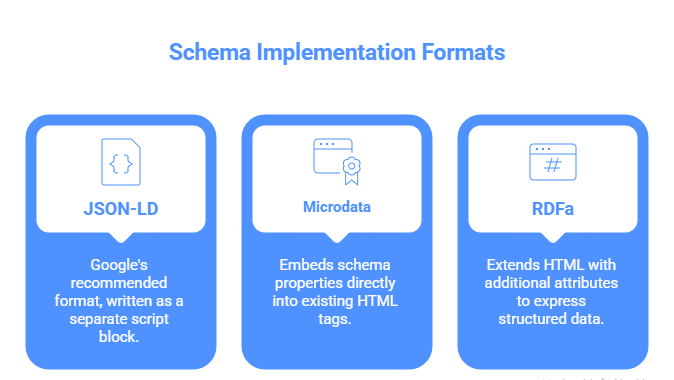
Schema markup can be written in three formats. Understanding which format to use and why Google strongly prefers one over the others is the starting point for any implementation.
JSON-LD: The Recommended Format
JSON-LD stands for JavaScript Object Notation for Linked Data. It is Google's officially recommended schema format and the one that should be used on any new implementation. JSON-LD is written as a separate script block placed in the head or body of the HTML page. It does not touch the visible HTML content of the page at all it sits alongside it as a self-contained data block.
The key advantage of JSON-LD is clean separation. The schema code is entirely independent of the page's visual markup. It can be added, edited, or updated without altering a single word of the visible content. This makes it easier to implement, easier to maintain, less prone to errors, and easier for Google to parse without interference from surrounding HTML. All schema implementation examples in this article use JSON-LD format.
Microdata: Embedded in HTML
Microdata embeds schema properties directly into the existing HTML tags of the visible page content. Rather than a separate script block, microdata uses attributes added to HTML elements itemscope, itemtype, and itemprop to tag specific portions of the rendered page content as schema properties.
Microdata works but creates tight coupling between the schema and the visual content. Editing the page content risks breaking the schema. Editing the schema risks disrupting the page layout. For most publishers, JSON-LD is significantly easier to manage. Microdata remains in use on older websites where it was implemented before JSON-LD became the standard, but it should not be chosen for new implementations.
RDFa: Linked Data in HTML Attributes
RDFa is an older format that extends HTML with additional attributes to express structured data. It functions similarly to Microdata in that it embeds within the visible HTML rather than sitting separately. It is supported by Google but rarely used in modern implementations. Publishers encountering RDFa on legacy sites should treat it as functional but not preferred, and plan to migrate to JSON-LD during any significant site rebuild.
The Schema Types That Directly Affect Direct Answer Generation
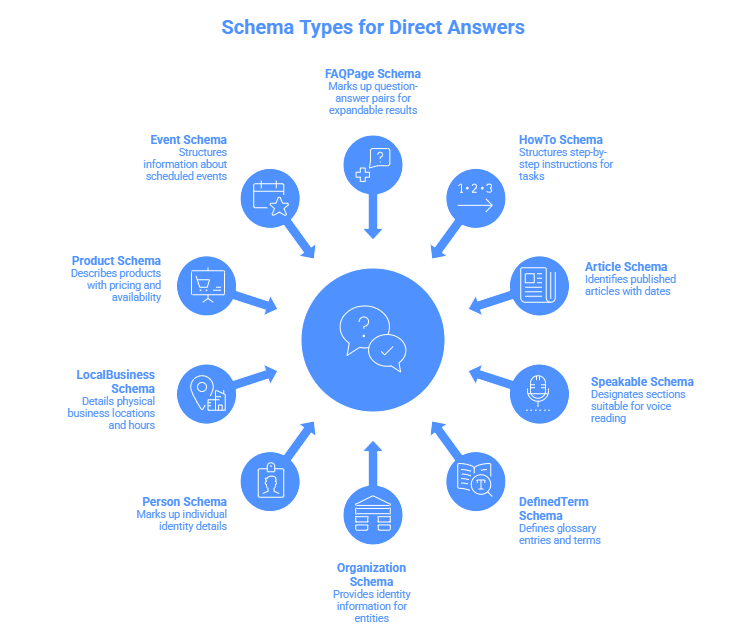
Not all schema types are relevant to direct answer generation. The types below are those with a direct documented relationship to specific direct answer formats in Google's results.
FAQPage Schema
FAQPage schema is the most directly impactful schema type for direct answer generation in AEO contexts. It declares a page as containing a list of frequently asked questions along with their answers, and marks up each question-and-answer pair individually so Google can read each pair as a discrete, self-contained direct answer unit.
When FAQPage schema is correctly implemented, Google can surface each marked-up question-and-answer pair as an expandable accordion directly within the organic search result listing. Users can read the answer without clicking through to the page. More significantly for direct answer purposes, the structured question-and-answer pairs are available to Google's systems as pre-labelled direct answer candidates for relevant queries the extraction decision has already been made by the publisher through the markup, not inferred by the search engine from page structure.
FAQPage schema is appropriate for pages that contain a genuine FAQ section multiple distinct questions each answered concisely. It is not appropriate for pages where a single question is asked and answered at length, or for pages where the questions are used as creative headings rather than as genuine user questions with direct answers.
HowTo Schema
HowTo schema declares a page or section as containing step-by-step instructions for completing a task. It marks up each step individually, with a name property for the step title and a text property for the step instruction. It can also mark up the total time required, the tools needed, and the materials involved.
For procedural direct answers the numbered step format triggered by how-to queries HowTo schema is the equivalent of FAQPage schema for question-and-answer content. It converts the inference-based extraction of a numbered list into a declared, machine-readable set of steps. Google can surface the steps directly in the results, with each step visible without requiring a click, and can use the structured step data to populate voice answers for procedural queries with high precision.
HowTo schema should be used on any page that teaches a process through discrete, sequential steps. It is particularly valuable for instructional content in categories where voice search is common cooking, home repair, software setup, exercise technique because voice assistants can read the structured steps one at a time in response to follow-up questions.
Article and NewsArticle Schema
Article schema and its subtype NewsArticle schema declare a page as a published article, identifying the headline, the author, the publication date, the date last modified, and the publishing organisation. For direct answer generation, the most important properties in Article schema are datePublished and dateModified.
When Google evaluates competing pages for a direct answer on a time-sensitive or evolving topic, the dateModified property in Article schema provides an explicit, machine-readable freshness signal. A page that has been updated recently and declares that update date through schema gives Google a clear, auditable freshness signal as opposed to a page that has been updated but carries no machine-readable date declaration, where freshness must be inferred from crawl history alone. Explicit freshness declarations through Article schema give Google higher confidence in the recency of the content.
Speakable Schema
Speakable schema is a direct answer schema type designed specifically for voice search. It marks up sections of a page that are particularly well-suited to being read aloud by voice assistants sections that are concise, self-contained, clearly phrased, and meaningful when delivered as audio without visual support.
The Speakable schema uses a cssSelector or xpath property to point Google to the specific sections of the page it has designated as speakable. Google's voice assistant systems use this designation to identify the optimal section to read in response to a voice query, rather than selecting a section through inference from the page's text structure.
Speakable schema is currently marked as experimental by Google and is available only to news publishers through the Google News programme in most markets. However, publishers in eligible categories should implement it on any page where a specific section has been written to meet voice answer requirements, as it represents the only publisher-controlled mechanism for directly nominating content for voice direct answer selection.
DefinedTerm and Glossary Schema
DefinedTerm schema, used within a DefinedTermSet, marks up glossary entries and term definitions as structured data. It declares each term, its definition, and its relationship to related terms within a defined vocabulary. For definitional direct answer queries what is X, what does X mean pages with DefinedTerm schema give Google an explicitly labelled definition to surface, rather than requiring Google to identify and extract the definition from unstructured paragraph text.
DefinedTerm schema is most valuable for websites that maintain a glossary or terminology section as a standalone resource marketing agencies defining industry terms, software documentation sites explaining technical concepts, legal or medical information sites defining specialist vocabulary. Any page built around the explicit purpose of defining terms is a strong DefinedTerm schema candidate.
Organization and Person Schema
Organization schema and Person schema mark up the identity information of the entity behind a website or a named individual. They declare properties including name, url, logo, description, founding date, address, contact information, and social media profiles for organisations and name, job title, affiliation, educational credentials, and published works for individuals.
For entity-based direct answers knowledge panel content and entity recognition across the results Organization and Person schema provide Google with a machine-readable identity declaration from the entity itself. This supplements and reinforces the external entity signals that Google gathers from third-party sources, and gives Google an authoritative primary source for the entity's identity properties. Websites that implement Organization or Person schema on their homepage and About page reduce the ambiguity in Google's entity recognition process and improve the accuracy of entity-based direct answers about them.
LocalBusiness Schema
LocalBusiness schema is a specialisation of Organization schema for businesses with a physical location. It adds properties for opening hours, price range, geographic coordinates, service area, and accepted payment methods. For local direct answers the result type that surfaces business hours, location details, and contact information in response to local queries LocalBusiness schema is the primary structured data input.
A business that implements LocalBusiness schema with accurate, current opening hours and geographic data gives Google a machine-readable source for local direct answer content that does not require inference from unstructured page text or sole reliance on Google Business Profile data. The two sources schema on the website and the Google Business Profile should carry identical information. Discrepancies between them introduce ambiguity that reduces Google's confidence in the local direct answer data.
Product and Offer Schema
Product schema marks up individual products with their name, description, image, brand, and associated offers including price, currency, availability, and condition. For direct answers on product-related queries, Product schema enables Google to surface price, availability, and rating information directly in the results as rich result enhancements.
The direct answer value of Product schema is primarily in the rich result format structured product information displayed within the organic listing rather than in position-zero featured snippet territory. For e-commerce and product-focused publishers, implementing Product schema with Offer schema on every product page is the mechanism by which pricing and availability appear directly in search results, putting key purchase-decision information in front of users before they reach the product page.
Event Schema
Event schema marks up scheduled events with their name, start date, end date, location, organiser, and ticketing information. For queries about upcoming events when is X happening, where is X taking place, how to get tickets for X Event schema provides Google with structured, machine-readable event data that can be surfaced in event-specific direct answer features in the results.
For publishers running events, conferences, webinars, or performances, implementing Event schema on every event listing page ensures that the structured event data is available for direct answer extraction. Without Event schema, Google must infer event details from unstructured text a process more prone to extraction errors than reading a clean machine-readable declaration of the event's properties.
How Each Schema Type Maps to a Specific Direct Answer Format
The relationship between schema type and direct answer format is consistent and predictable. Each schema type enables or enhances a specific category of direct answer surface. Understanding this mapping prevents implementing the wrong schema for the intended result.
- FAQPage schema maps to FAQ accordion rich results within organic listings and to question-and-answer direct answer candidates for informational queries.
- HowTo schema maps to step-by-step rich results within organic listings and to voice-delivered procedural direct answers for how-to queries.
- Article and NewsArticle schema map to freshness-sensitive direct answer selection by providing explicit date signals for time-sensitive informational queries.
- Speakable schema maps directly to voice search answer selection for eligible publishers, nominating specific sections for spoken delivery.
- DefinedTerm schema maps to definitional direct answers for vocabulary and terminology queries.
- Organization and Person schema map to knowledge panel content and entity-based direct answers for branded and biographical queries.
- LocalBusiness schema maps to local direct answers for opening hours, location, and service-area queries.
- Product and Offer schema map to product rich results displaying price and availability within organic listings.
- Event schema maps to event-specific direct answer features for queries about scheduled events.
Common Schema Implementation Errors That Invalidate Direct Answer Eligibility
Incorrectly implemented schema does not simply fail to help it can actively signal poor quality to Google's systems and, in cases where it violates Google's structured data guidelines, can result in the schema being ignored entirely or the page receiving a manual action. These are the errors that most commonly prevent schema from contributing to direct answer generation.
Marking Up Content That Is Not Visible on the Page
Google's structured data guidelines require that the content described in schema markup must be present and visible to users on the page. Marking up content in schema that does not appear in the page's visible text adding answers to FAQPage schema that are not displayed on the page, for example violates the guidelines and will result in the schema being discarded. Schema is a declaration of what the page contains, not an opportunity to add additional content that bypasses the page itself.
Using FAQPage Schema on Pages With Only One Question
FAQPage schema is intended for pages that contain multiple question-and-answer pairs that represent genuine frequently asked questions. Applying FAQPage schema to a page that contains a single question, or to a page where the questions are rhetorical devices rather than real user queries with direct answers, misuses the schema type. Google's quality reviewers assess schema usage for appropriateness, and inappropriate use of FAQPage schema is a known trigger for schema validity warnings.
Inaccurate or Outdated Property Values
Schema properties that contain inaccurate information wrong opening hours in LocalBusiness schema, a product price in Offer schema that no longer matches the actual price, an event date in Event schema that has passed create discrepancies between what the schema declares and what the page displays or what is actually true. Google's systems cross-reference schema property values against the page content and against external signals. Persistent inaccuracies in schema properties reduce the trust Google places in the schema and, by extension, in the page's direct answer eligibility.
Nesting Schema Types Incorrectly
Many schema types are designed to nest within each other a HowTo schema can contain HowToStep elements, an FAQPage can contain Question and Answer elements, a Product schema can contain an Offer schema. Errors in nesting declaring child elements outside their required parent type, omitting required parent declarations, or confusing the hierarchy of types produce schema that Google can parse partially but not completely. Partial schema is less effective than complete schema and may produce no direct answer benefit at all if the critical parent-child relationships are malformed.
Implementing Schema Without the Required Properties
Every schema type has required properties properties that must be present for the schema to be considered valid by Google's structured data parser. FAQPage requires at least one Question with an acceptedAnswer. HowTo requires a name and at least one step. Organization requires a name and a url. Missing required properties produce an invalid schema declaration that Google cannot act on for direct answer purposes, even if the surrounding optional properties are correctly implemented.
How to Test and Validate Schema Implementation
Every schema implementation should be tested before and after publication using Google's own validation tools. There are two primary tools available, each serving a different validation purpose.
Google's Rich Results Test
The Rich Results Test, available at search.google.com/test/rich-results, evaluates a specific URL or code snippet and reports whether the schema on that page is valid and eligible to generate rich results in Google Search. It identifies detected schema types, lists any errors or warnings in the implementation, shows which rich result features the page is eligible for based on the schema found, and previews how the rich result would appear in search results if selected.
The Rich Results Test should be run on every page immediately after schema is implemented and after any subsequent update to the schema or the surrounding page content. An error-free result confirms that the implementation meets Google's technical requirements for direct answer and rich result eligibility.
Google Search Console Rich Results Report
Google Search Console provides a Rich Results report under the Search Appearance section that tracks the performance and validity of schema across an entire website over time. The report shows how many pages with each schema type are valid, how many have warnings, how many have errors, how many impressions schema-enhanced results are receiving, and how many clicks those results are generating.
The Search Console Rich Results report is the ongoing monitoring tool for schema performance at scale. A spike in errors indicates a recent code change that has broken schema across affected pages. A decline in impressions for a specific schema type may indicate that Google has changed its eligibility criteria or that the schema is being suppressed for a quality reason. Both warrant investigation and correction.
Schema.org Validator
The Schema.org validator, available at validator.schema.org, checks schema code against the Schema.org specification rather than against Google's specific rich result requirements. It identifies structural errors in the schema vocabulary incorrect type names, invalid property values, improperly formed JSON-LD syntax that may not always be caught by the Rich Results Test. Running both validators on new schema implementations catches the broadest range of potential errors before the schema reaches the live site.
Schema as Part of a Complete Direct Answer Strategy
Schema markup is not a standalone solution for direct answer generation. It is a multiplier applied to content that already meets the quality, structure, and authority standards required for direct answer eligibility. A page with perfect schema implementation but poor content quality, weak site authority, or unstructured answers will not earn direct answer positions. A page with strong content, good structure, and correct schema implemented on top of that foundation is significantly more competitive than the same page without schema.
The practical priority order for direct answer work is: write the correct answer content, structure it appropriately for the query type, ensure the website meets the baseline trust and technical health requirements, and then implement schema to declare and label what the content already contains. Schema confirms to Google what it should already be able to infer from well-written, well-structured content. When both the inference and the declaration point to the same conclusion, Google's confidence in selecting that content as the direct answer source is at its highest.
- Implement FAQPage schema on every page with a genuine multi-question FAQ section. This is the highest-return schema implementation for most informational content publishers.
- Implement HowTo schema on every instructional page teaching a process through numbered steps. Prioritise pages in categories where voice search is common.
- Add Article schema with accurate datePublished and dateModified properties to all informational articles. Keep dateModified current when content is updated.
- Implement Organization schema on your homepage and About page with complete, accurate identity properties that match your Google Business Profile and external directory listings.
- Add LocalBusiness schema if you operate a physical location. Keep opening hours and contact details in schema synchronised with your Google Business Profile.
- Run the Rich Results Test immediately after every schema implementation and after any page update that touches schema code or the content it describes.
- Monitor the Search Console Rich Results report monthly for errors, warnings, and changes in impression volume across all schema types.
Frequently Asked Questions
Final Thoughts
Schema markup occupies a unique role in the direct answer ecosystem. It is the only mechanism by which a publisher can communicate directly to Google's systems what the content is, what role each part of it plays, and which sections are direct answer candidates without relying on Google to infer those things from the page structure alone.
Every other aspect of direct answer optimisation writing quality, heading structure, content freshness, website authority operates at the level of making it easier for Google to reach the right inference about the content. Schema operates at a different level entirely. It replaces inference with declaration. That shift from inference to declaration is the core value of schema markup in the direct answer generation process.
Implement the right schema types for the content you publish. Validate every implementation before it goes live. Keep schema property values accurate and current. Monitor performance through Search Console. These four practices applied consistently across a website's direct answer content give Google the clearest possible instruction on where the answers are and what they mean and that clarity is what earns the position.
Schema does not ask Google to trust your content. It shows Google exactly what your content is and makes trust the only logical conclusion.