SEO vs. AEO vs. GEO: A Strategic Framework for Prioritization
TL;DR:
The question of which to focus on—SEO, AEO, or GEO—is one of the most pressing decisions facing digital marketers in 2026. This guide provides a clear framework for making that decision strategically, based on your business goals and current digital maturity.
Why This Is Not an Either-Or Decision
The framing of SEO versus AEO versus GEO implies that choosing one means abandoning the others. That is a misleading way to think about it. All three disciplines share a common foundation: quality content, technical website health, credible backlinks, and genuine expertise demonstrated consistently over time. The work you do for one almost always benefits the others.
A page optimised for AEO with an answer-first structure, question-based headings, and schema markup almost always ranks better in traditional Google search as well. A brand that invests in GEO through digital PR and consistent publishing earns the authority signals that improve both SEO rankings and AEO citation rates. Thinking of these disciplines as mutually exclusive leads to siloed strategies that underperform.
The real question is not which one to focus on, but where to allocate your primary effort given your current position and the specific outcomes you are trying to achieve. Each discipline delivers different results on different timelines, and understanding those differences is what makes a prioritisation decision genuinely strategic.
What Each Discipline Delivers and When
Before deciding where to focus, it is worth being clear about what each discipline is actually optimised to deliver because the outcomes are distinct even when the inputs overlap.
What SEO Delivers
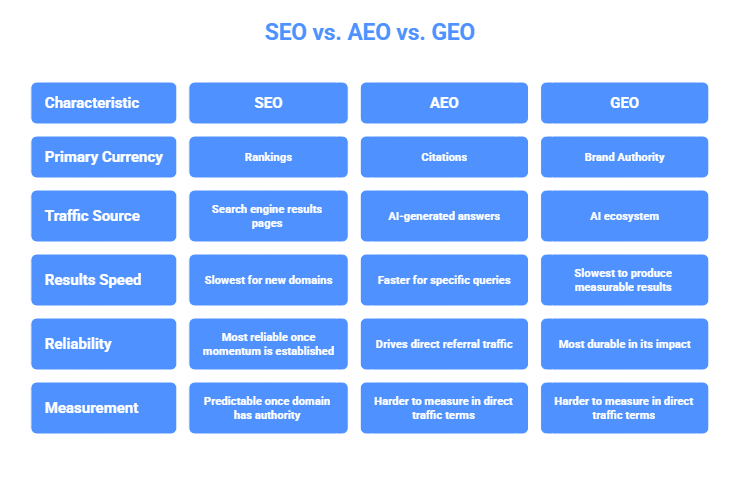
SEO delivers sustainable organic traffic from users who click through search engine results pages to visit your website. Its primary currency is rankings—higher positions for target keywords translate directly into more visibility and more traffic. SEO results are relatively predictable once a domain has established authority, and the infrastructure it builds—indexed pages, backlink profiles, technical health—forms the foundation that everything else depends on. SEO is the slowest to produce initial results for new domains but the most reliable and long-lasting once momentum is established.
What AEO Delivers
AEO delivers visibility inside AI-generated answers—the citations, source references, and content extracts that appear when users ask questions on platforms like Google AI Overviews, Perplexity, and Microsoft Copilot. Its primary currency is citations rather than rankings. AEO success means your content is the answer an AI engine presents, regardless of whether the user clicks through to your site. For platforms like Perplexity that display clickable source links, AEO also drives direct referral traffic. AEO can produce results faster than traditional SEO for specific queries, particularly on Perplexity, but requires an existing foundation of domain credibility to compete for Google AI Overview citations.
What GEO Delivers
GEO delivers brand presence within the AI ecosystem—the accuracy, frequency, and quality of how your brand is represented when AI models discuss your industry, category, or competitors. Its primary currency is brand authority within AI systems rather than individual page citations or search rankings. GEO outcomes are harder to measure in direct traffic terms but have significant long-term impact on brand awareness, perceived authority, and the likelihood of being recommended by AI platforms in broader, non-citation-based interactions. GEO is the slowest of the three to produce measurable results but the most durable in its impact on brand positioning.
The Case for Prioritising SEO First
For the majority of businesses—especially those with a website less than three years old, limited domain authority, or a content library that has not yet been systematically built—SEO should be the primary foundation. The reason is simple: both AEO and GEO depend on the credibility signals that SEO builds. Without indexed pages that rank reasonably well, without a backlink profile that signals trustworthiness, and without a technically healthy website that crawlers can access cleanly, neither AEO content optimisation nor GEO brand building will reach its potential.
Google AI Overviews—the highest-traffic AEO opportunity—almost exclusively draws from pages that already have significant organic ranking authority. Attempting AEO optimisation without an SEO foundation is like trying to win a citation race you have not yet qualified to enter. Build the foundation first, and AEO improvements will compound on top of it far more effectively.
SEO should be your primary focus if:
- Your website is less than two to three years old
- Your domain authority is below 30 on standard measurement scales
- You have fewer than fifty properly indexed, content-rich pages
- Your organic traffic is still in early growth stages
- You have significant technical issues affecting crawlability or page speed
In this situation, applying AEO and GEO principles to every piece of content you create is still worthwhile because content built to answer questions clearly and structured with schema markup will perform better in both traditional search and AI citations than content that ignores these principles. The difference is that SEO should drive your strategy, with AEO and GEO layered on top of it.
The Case for Prioritising AEO Next
Once a business has an established SEO foundation—consistent organic traffic, a healthy domain authority, and a library of indexed content—AEO becomes the highest-leverage next investment. This is the point at which the structural and authority work of SEO can be directly leveraged to earn AI citations, and where incremental content improvements produce disproportionate visibility gains.
The opportunity cost of not investing in AEO at this stage is significant. A business that ranks on page one for important queries but has not optimised its content for AI extraction is leaving the most visible position on that results page—the AI Overview above all organic links—entirely to competitors. Every month without AEO investment at this stage is a month in which competitors with the same or lower authority are potentially earning citations your content could have claimed.
AEO should become your primary focus if:
- You already rank consistently for target keywords but are not appearing in AI Overviews or Perplexity citations
- Your organic traffic has plateaued and traditional SEO tactics are producing diminishing returns
- You have noticed competitors appearing in AI-generated answers for queries where you have relevant content
- Your impressions in Google Search Console are growing but your click-through rate is declining—a sign that AI Overviews are answering queries before users reach your links
- Your audience is increasingly using conversational AI tools rather than traditional search to research your industry
AEO at this stage does not replace SEO activity; it runs alongside it. The content restructuring, schema implementation, and topical authority building that AEO requires will also strengthen your SEO performance, making the investment doubly efficient.
The Case for Investing in GEO as a Long-Term Strategy
GEO operates on the longest timeline of the three disciplines and produces results that are the hardest to attribute directly to specific actions. This makes it the easiest to deprioritise in the short term and the most costly to neglect over the long term. Businesses that build strong GEO presence consistently find that it accelerates both SEO and AEO performance over time, because the brand authority signals it generates are the same signals that search engines and AI engines use to evaluate trustworthiness.
GEO is not a discipline you turn on when your SEO and AEO are performing well. It is a discipline you build in parallel from the moment you begin publishing content, because every piece of original research, every credible media mention, and every consistent brand narrative you put into the world contributes to the AI model training data that will determine how your brand is represented in generative AI outputs for years to come.
GEO deserves dedicated investment if:
- Your brand is absent from AI-generated category discussions even when direct competitors appear
- AI platforms describe your brand inaccurately or with outdated information
- You are in a competitive market where brand trust is a primary purchase driver
- Your target audience heavily uses AI tools for research before making purchasing decisions
- You have the content and SEO foundation in place and are ready to invest in long-term brand positioning
How to Decide Based on Your Specific Business Situation
Rather than applying a generic framework, the most effective prioritisation decision comes from honestly assessing your current situation against the signals that indicate where the highest-leverage opportunity lies. Here is how to think through that assessment.
If You Are a New or Early-Stage Business
Your primary focus should be building an SEO foundation while applying AEO content principles to everything you publish from day one. This means targeting specific, niche questions your audience asks rather than broad keywords, structuring every article with answer-first writing and question-based headings, and adding schema markup as a standard part of your publishing process. The AEO structure costs you nothing extra and makes your content more competitive in both traditional and AI search from the start. GEO investment at this stage is light—focus on producing original, quotable content that earns natural media mentions as your authority grows.
If You Are an Established Business With Strong SEO
Your highest-leverage opportunity is almost certainly AEO. You have the authority and the indexed content; what you likely lack is the structural optimisation that allows AI engines to extract clean answers from your pages. Audit your top twenty to fifty informational pages against AEO criteria, restructure them with answer-first openings and FAQ sections, implement schema markup across the board, and monitor your AI citation performance monthly. The results from this investment are typically faster and more pronounced than any equivalent SEO effort at this stage, because you are improving selection eligibility for AI Overviews you are already close to qualifying for.
If You Are a Brand With High Awareness but Low AI Visibility
If your brand is well-known in your industry but absent or underrepresented in AI-generated outputs, GEO deserves primary attention alongside AEO. This situation often affects established businesses that have strong offline or paid digital presence but have underinvested in organic content and brand storytelling. The fix involves publishing original research and thought leadership that earns citations from credible sources, building media relationships that generate accurate brand mentions in publications AI models draw from, and auditing the accuracy of your brand information across every web property where it appears.
If You Are in a Highly Competitive Niche
In competitive niches where broad keywords are dominated by high-authority players, the most effective strategy is to lead with AEO on specific, niche question-based queries where the competition for AI citations is lower, while continuing to build SEO authority through topical depth rather than keyword breadth. GEO investment in competitive niches pays off through differentiation—if your brand consistently appears alongside or ahead of well-known competitors in AI-generated category discussions, it signals credibility that converts even when users arrive without prior brand awareness.
The Integrated Approach: Running All Three Simultaneously
For businesses with the resources to invest in all three disciplines simultaneously, the integrated approach is not just possible—it is the most powerful digital marketing strategy available in 2026. When SEO, AEO, and GEO are running in parallel and feeding each other, the compounding effect is significantly greater than the sum of the three individual strategies.
SEO builds the authority foundation that makes AEO citations more likely and GEO brand presence more credible. AEO earns citations that drive traffic, build brand awareness, and contribute to the web presence that strengthens GEO signals. GEO generates the brand authority and media mentions that enhance both SEO rankings and AEO citation rates. The three disciplines form a reinforcing loop, each one making the other two more effective over time.
Running all three requires clear ownership, consistent measurement, and a content strategy that serves all three purposes simultaneously. Tools like SEMAI that provide integrated visibility tracking across SEO performance, AEO citation monitoring, and GEO brand presence across AI platforms make this approach significantly more manageable for teams that cannot afford to split their attention across three separate measurement systems.
The One Rule That Applies Regardless of Which You Prioritise
Whether you are leading with SEO, investing primarily in AEO, or building long-term GEO brand presence, one rule applies across all three without exception: the quality of the content you publish is the single most important variable in your success.
Search engines rank quality content. AI engines cite quality content. Generative models absorb and represent quality content in their outputs. No amount of structural optimisation, schema implementation, or digital PR will compensate for content that is shallow, inaccurate, or written without genuine expertise behind it. The businesses that win across all three disciplines are the ones that treat every piece of content as an opportunity to be the most genuinely useful, credible, and clear voice in their space.
That standard—genuinely useful, credible, and clear—is the common thread running through SEO, AEO, and GEO. Build your content to that standard first, then layer the specific optimisation requirements of each discipline on top. Everything else follows from that foundation.
Frequently Asked Questions
Final Thoughts
The question of SEO versus AEO versus GEO is ultimately a question of sequencing and emphasis, not exclusion. All three disciplines are necessary for sustainable digital visibility in 2026. The right answer for your business depends on where your foundations are today, what your immediate and long-term goals are, and where the highest-leverage gaps in your current visibility strategy lie.
Start with an honest audit of your current position. Identify whether your primary constraint is a weak SEO foundation, a failure to earn AI citations despite strong rankings, or an absence from the brand-level AI conversations that influence your industry. The answer to that audit tells you exactly where to focus first, and the content principles that underpin all three disciplines mean that effort invested in any one of them rarely goes to waste on the others.
The brands that will dominate digital marketing in the years ahead are not the ones that chose correctly between SEO, AEO, and GEO. They are the ones that understood all three, built them together, and never stopped investing in any of them.