What Types of Queries Most Commonly Trigger Direct Answers?
TL;DR:
Not every question earns an answer on the results page. The queries that do share very specific patterns and once you recognise those patterns, you can write directly into them.
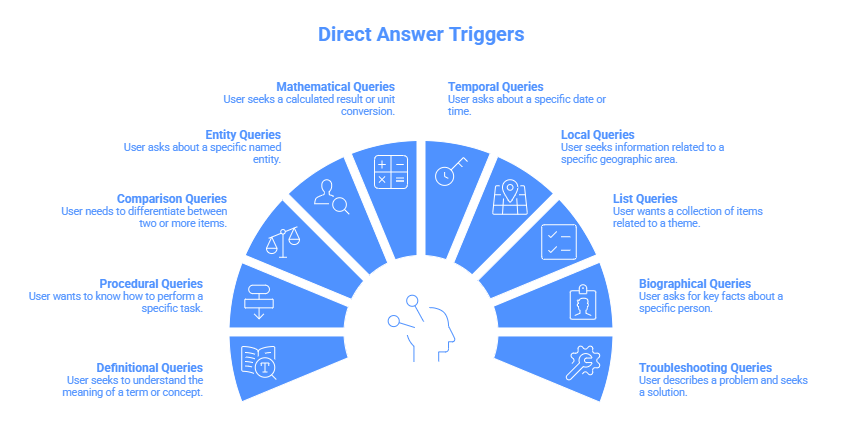
Direct answers are not awarded randomly. Search engines trigger them for query types that consistently share the same characteristics: a bounded answer, a clear intent, and a user need that is fully served without leaving the results page. Knowing which query types fall into this category is the most practical starting point for any AEO content plan. This article breaks down every major query category that most commonly triggers direct answers, with examples and content guidance for each.
1. Definitional Queries
Definitional queries are among the highest-frequency direct answer triggers across every search platform. The user wants to know what something is: a term, a concept, a process, or an idea they have encountered and need explained.
These queries follow a highly consistent structure. They begin with 'what is', 'what are', 'what does', or 'what does X mean'. The search engine recognises this structure as a request for a definition and looks for a concise, clearly stated explanation from a credible source.
Examples of definitional queries:
- What is machine learning?
- What is the meaning of GDP?
- What are antioxidants?
- What does AEO stand for?
Content Guidance: For content creators, definitional queries represent the clearest opportunity in the direct answer space. The format requirement is straightforward: open with a single sentence that defines the term directly, follow with two to three sentences of context, and keep the entire passage under sixty words. Search engines extract the opening definition sentence most frequently for this query type—make it impossible to misread.
2. Procedural Queries
Procedural queries ask how to do something. The user wants a sequence of steps, a method, or a process they can follow to achieve a specific outcome. This query type is one of the most consistent direct answer triggers because it maps naturally to numbered list format—a clean, extractable structure that search engines handle with high confidence.
Procedural queries are typically introduced with 'how to', 'how do I', 'how do you', 'steps to', or 'ways to'. The presence of a clear action verb alongside the question word signals to the search engine that the user wants a process, not a discussion.
Examples of procedural queries:
- How to write a cover letter?
- How do I reset my password?
- Steps to start a podcast?
- How to bake sourdough bread?
Content Guidance: Content targeting procedural queries should be structured as numbered lists with short, action-oriented steps. Each step should begin with a verb. The list should be immediately beneath a heading that mirrors the query phrasing. Procedural queries that are answered in paragraph form rather than numbered steps are consistently passed over in favour of list-formatted content that search engines can extract and render cleanly.
3. Comparison Queries
Comparison queries ask for the difference between two or more things: concepts, products, approaches, or terms that users frequently confuse or need to evaluate against each other. This query type triggers direct answers when the comparison has a clear, objectively statable outcome or when the key differences can be listed concisely.
Comparison queries are introduced with 'what is the difference between', 'X vs Y', 'how does X compare to Y', or 'which is better X or Y'. The 'versus' pattern is particularly strong; it signals a side-by-side evaluation need that search engines actively look for structured content to answer.
Examples of comparison queries:
- What is the difference between SEO and AEO?
- HTTP vs HTTPS what is the difference?
- How does RAM differ from ROM?
- Inbound vs outbound marketing?
Content Guidance: For comparison queries, the most effective content structure is a short introductory sentence that names the core distinction, followed by a brief explanation of each item being compared, and a closing sentence that summarises the key difference. Avoid lengthy side-by-side analysis in the extractable section; search engines look for a clear, scannable comparison that can be surfaced as a direct answer without requiring the user to read an entire article.
4. Entity and Identity Queries
Entity queries ask who or what a specific named thing is: a person, an organisation, a place, a product, or a well-known concept with a distinct identity. These queries trigger direct answers through knowledge panels and entity-based answer boxes, which draw from structured databases rather than individual web pages.
Entity queries are introduced with 'who is', 'who was', 'what is', 'where is', or simply the name of the entity alone. When a search engine recognises the query as a lookup for a specific named entity it has data on, it surfaces structured facts directly rather than returning a list of pages about that entity.
Examples of entity queries:
- Who is Elon Musk?
- What is NASA?
- Where is the Colosseum?
- Who founded Apple?
Content Guidance: For businesses and brands, entity queries about their own name represent an opportunity to control what the direct answer surfaces. Maintaining a complete and accurate Google Business Profile, a well-structured Wikipedia or Wikidata presence, and consistent entity information across authoritative third-party sources all improve the accuracy and completeness of the direct answer that appears when users search for the brand by name.
5. Mathematical and Unit Conversion Queries
Mathematical queries and unit conversion queries are among the oldest and most reliable direct answer triggers. They ask for a calculated result, a converted value, or a numerical fact and because the answer is objectively correct and computed rather than interpreted, search engines deliver it directly with near-total confidence.
These queries take the form of calculations typed directly into the search bar, conversion requests using 'in' or 'to', or questions asking for a numerical quantity.
Examples of mathematical and conversion queries:
- How many kilometres in a mile?
- What is 15% of 240?
- Convert 100 dollars to euros?
- How many days in a leap year?
Content Guidance: Content creators rarely compete for direct answers on pure calculation queries; these are handled by search engine internal calculators, not publisher content. The opportunity in this category is for content that adds context around the calculation. A page that explains not just how many calories are in a gram of protein but what that means for daily intake provides both the direct numerical answer and the surrounding value that earns the page citation as a source for more complex related queries.
6. Temporal Queries
Temporal queries ask when something happened, when something will happen, or what the current date or time is in a specific context. These queries trigger direct answers because the answer is a specific point in time—a date, a year, a duration—that can be stated in a single line without ambiguity.
Temporal queries are introduced with 'when did', 'when was', 'when is', 'what year did', or 'how long ago'. They can also take the form of a simple present-tense question where the answer is a date or time period.
Examples of temporal queries:
- When did the First World War end?
- When was the iPhone first released?
- What year was the Eiffel Tower built?
- How long does it take to fly from London to New York?
Content Guidance: For evergreen temporal queries—historical dates, founding years, duration facts—content that states the answer clearly in the opening sentence of a relevant section is well positioned for direct answer selection. For time-sensitive temporal queries, content needs to be kept updated. A page that gives a date which has since changed will lose its direct answer position to a more recently updated source.
7. Local and Location-Based Queries
Local queries ask for information tied to a specific geographic area: a nearby business, a local service, opening hours, directions, or location-specific facts. These queries trigger direct answers through local search panels, map integrations, and location-aware result boxes that surface information relevant to the user's detected location.
Local queries are introduced with 'near me', 'in' followed by a location name, 'closest', or simply by appending a city, neighbourhood, or region to a search term. The search engine uses the user's location data to determine which local direct answer to surface.
Examples of local queries:
- Dentist near me?
- What time does Tesco close tonight?
- Best coffee shop in Manchester?
- Pharmacies open now in Chennai?
Content Guidance: For businesses with a physical presence, local queries are the most direct path to a direct answer position. A complete and accurate Google Business Profile with correct opening hours, address, phone number, category, and regularly updated information is the primary input for local direct answer selection. Businesses that keep this information current and consistent across all listing platforms consistently outperform those that do not in local direct answer visibility.
8. List and Enumeration Queries
List queries ask for a collection of items: types, examples, reasons, benefits, steps, or categories that belong together under a common theme. These queries trigger direct answers through bulleted or numbered list extractions, where the search engine surfaces the list from the source page as a structured direct answer.
List queries are introduced with 'what are the types of', 'examples of', 'list of', 'reasons why', 'benefits of', or 'causes of'. The plural structure of the question signals that multiple items are expected and that a list-formatted answer is the appropriate response.
Examples of list queries:
- What are the types of renewable energy?
- Examples of cognitive biases?
- What are the benefits of intermittent fasting?
- Causes of inflation?
Content Guidance: Content targeting list queries should be structured as clean bulleted or numbered lists immediately beneath a heading that mirrors the query. Each list item should be a complete, self-contained point—not a sentence fragment that requires the surrounding paragraph to make sense. Search engines extract the list itself, not the surrounding prose, so every item in the list must stand on its own.
9. Biographical Queries
Biographical queries ask for key facts about a specific person: their age, nationality, profession, achievements, or life dates. These queries trigger direct answers through knowledge panels and entity boxes that surface structured biographical data from authoritative sources.
Biographical queries are introduced with 'how old is', 'where was X born', 'what is X known for', or 'who is' followed by a person's name. The answer is a specific fact or short collection of facts that can be stated in one or two lines.
Examples of biographical queries:
- How old is Serena Williams?
- Where was Albert Einstein born?
- What is Stephen Hawking known for?
- Who is the author of Harry Potter?
Content Guidance: For public figures, organisations, or brands seeking to influence what biographical direct answers say about them, the most effective strategy is consistent, accurate entity data across Wikipedia, official websites, and authoritative third-party directories. Search engines compile biographical direct answers from these sources; inconsistency or inaccuracy in any of them can result in incorrect information appearing in the direct answer.
10. Troubleshooting Queries
Troubleshooting queries describe a problem and ask for a solution. The user is experiencing a specific issue and wants actionable steps to resolve it. These queries trigger direct answers when the problem is common enough that a reliable, generalisable solution exists and when that solution can be stated in a short list of steps or a direct recommendation.
Troubleshooting queries are introduced with 'why is X not working', 'how to fix', 'what to do when', or 'how do I resolve'. The problem is usually described concisely and the expected answer is a remedy.
Examples of troubleshooting queries:
- Why is my Wi-Fi not connecting?
- How to fix a slow computer?
- What to do when iPhone won't turn on?
- Why is my email not sending?
Content Guidance: Troubleshooting content performs best as a short numbered list of solutions ordered from most common to most technical. The first one or two steps should address the most frequent cause of the problem; search engines favour answers that are broadly applicable, not niche edge cases. Including the problem description in the heading, matching the exact phrasing a frustrated user would type, significantly improves direct answer selection for this query type.
Frequently Asked Questions
Definitional and procedural queries are generally the most accessible direct answer opportunities for content creators. Both have highly predictable structures, clear formatting requirements, and answer lengths that fit cleanly within direct answer boxes. They also represent a large share of everyday search volume, making them high-reward targets relative to the effort required to optimise for them.
Yes, and this is a common approach in strong AEO content. A comprehensive article on a topic can include a definitional section that targets 'what is' queries, a procedural section that targets 'how to' queries, a list section that targets 'what are the types of' queries, and an FAQ section that targets multiple question-based queries simultaneously. Each section is optimised for its own query type while the page as a whole builds topical authority.
Consistency of direct answer triggering depends on how reliably the search engine can find a high-quality, clearly structured answer in its index for that query. Query types like conversion and entity lookups trigger direct answers almost every time because the answers are computed or drawn from structured databases. Query types like comparisons and troubleshooting trigger direct answers less consistently because the quality and extractability of available content varies more widely across the index.
Voice search queries are not a separate category in terms of type; they map to the same ten query types covered in this article. What distinguishes them is phrasing. Voice queries tend to be longer, more conversational, and more explicitly question-shaped than typed queries covering the same intent. A typed query might be 'capital of France' a voice query for the same need is 'what is the capital of France'. Both fall into the entity query category, but the voice version is more directly optimised for direct answer selection already.
Search the questions your audience asks most frequently and observe what the results page currently shows. If direct answers are already appearing for similar queries in your space, that query type is proven for your industry. Tools like Google Search Console reveal which question-phrased queries are already sending impressions to your pages—these are the starting points for identifying which query types to target first.
Final Thoughts
The ten query types covered in this article—definitional, procedural, comparison, entity, mathematical, temporal, local, list, biographical, and troubleshooting—account for the large majority of direct answer placements across all search platforms. Each type has its own structure, its own content requirements, and its own optimisation approach.
The most effective AEO strategies are built by identifying which of these query types are most active in a specific topic area, then producing content that is purpose-built for the format each type demands. Generic content that does not match any of these patterns earns organic rankings at best. Content that maps precisely to a query type earns the direct answer position that sits above them.
Know your query type before you write. Structure your content to match it. The direct answer position belongs to the page that made the right choice before it wrote a single word. The queries that earn direct answers are not lucky. They are built to match the pattern the search engine is already looking for.