Google AI Overviews: The Complete Guide for 2026
TL;DR:
A deep dive into how AI Overviews work, their impact on website traffic, and a complete, actionable framework to get your content featured in the new era of search.
Optimize for AIOsConsult an ExpertWhat Are Google AI Overviews?
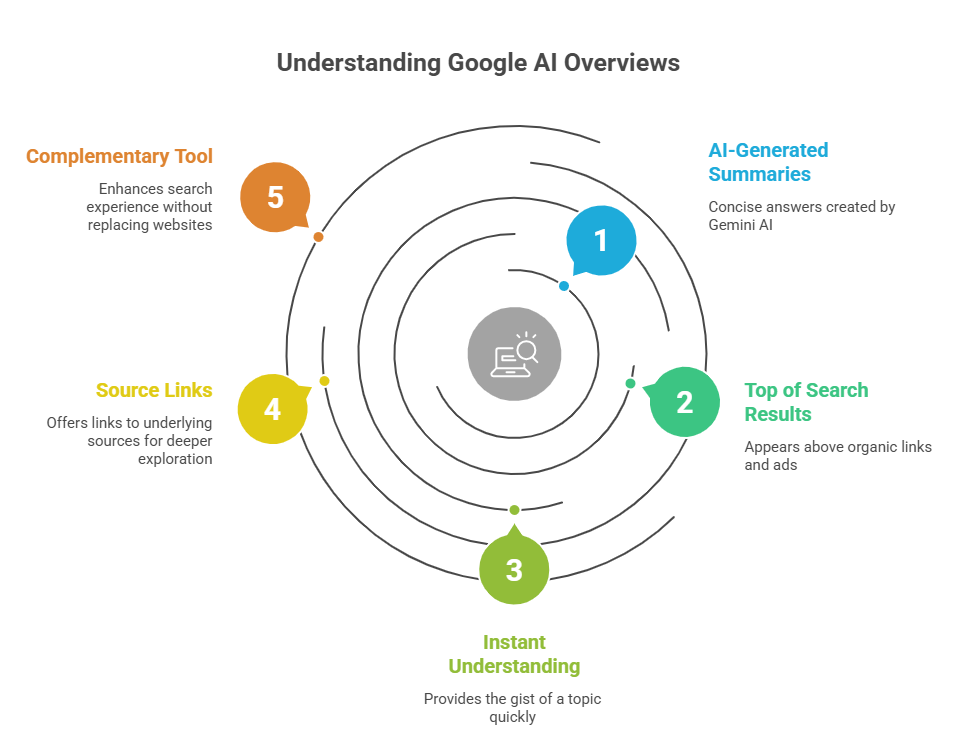
Google AI Overviews (AIOs) are AI-generated answer summaries that appear at the very top of Google Search results, above all organic links, ads, and featured snippets. When you type a question into Google, instead of only seeing a list of web links, you now often see a concise, synthesised paragraph or bullet-point answer generated by Google's Gemini AI.
They are designed to give you the 'gist' of a topic instantly, with links to the underlying sources on the right side so you can explore further. The goal is not to replace websites, but to help users understand complex topics faster before diving deeper.
A Short History
- May 2023: Introduced as 'Search Generative Experience' (SGE), US Labs only.
- May 2024: Rebranded as 'AI Overviews'; officially launched across the United States.
- Aug–Oct 2024: Rolled out to UK, India, Japan, Brazil, Mexico, and 40+ more countries.
- Early 2025: Expanded to Europe: Germany, France, Italy, Spain, and others.
- Mid 2025: Powered by Gemini 2.5 in the US; available in 200+ countries, 40+ languages.
- Late 2025: Google's 'AI Mode' launched as a deeper conversational search layer.
What Does an AI Overview Look Like?
- A clear 'AI Overview' label with Google's colored G icon.
- A paragraph or bulleted list directly answering your query.
- 3–6 expandable reference links on the right, crediting sources.
- A link to continue exploring in Google's full AI Mode.
- Interactive text highlighting for definitions and related images.
How Do Google AI Overviews Work?
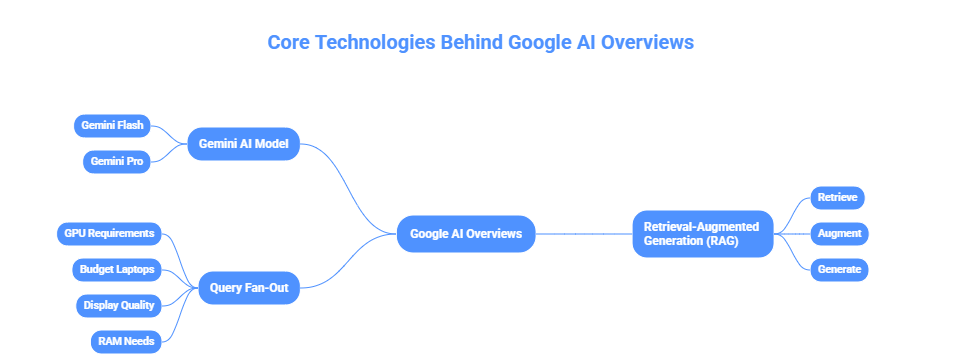
Three core technologies work together to produce every AI Overview: a powerful AI model (Gemini), a grounding technique called Retrieval-Augmented Generation (RAG), and a query expansion method called Query Fan-Out.
The Gemini AI Model
Powered by Google's Gemini family of LLMs, which can process text, images, and code. It uses 'Gemini Flash' for speed on simple queries and 'Gemini Pro' for complex, multi-step reasoning.
Retrieval-Augmented Generation (RAG)
The AI fetches fresh, real web content at the time of your search and grounds its answer in that content. This is why AIOs cite sources and can reference recent events, reducing hallucinations.
Query Fan-Out
Your single question is 'fanned out' into multiple related sub-questions that are searched simultaneously. The AI then synthesizes the findings into one comprehensive answer.
When Does an AI Overview Appear?
Triggers an AI Overview:
- 'What is X?' / 'How does Y work?'
- Complex multi-part questions
- Science, tech, history, how-to topics
- Comparison queries: 'X vs Y'
- Research-style knowledge queries
Does NOT trigger an AI Overview:
- 'Buy iPhone 15 near me' (transactional)
- 'Facebook login' (navigational)
- Breaking news or real-time events
- Highly sensitive health/legal decisions
- Simple one-word or brand-name searches
How Widespread Are AI Overviews?
AI Overviews have expanded rapidly and are now a permanent fixture of Google Search. Independent research from 2025 shows they appear in 15-30% of all searches, with higher saturation in informational categories.
- SE Ranking (May 2025): Detected in ~30% of tracked US queries.
- Conductor (July 2025): Found in 16% of 118 million keywords tracked.
- Semrush (Nov 2025): Coverage at ~16% after peaking at ~25% in mid-2025.
- By Category: Science leads at ~26%, followed by Computers & Electronics (~18%).
Impact on SEO & Website Traffic
The relationship between AI Overviews and traffic is nuanced, presenting both significant threats and new opportunities for visibility.
The Traffic Threat: Zero-Click Searches
When an AIO answers a question completely, users may not click any link. Research shows the click-through rate (CTR) for the #1 organic result drops by ~34.5% when an AIO is present. This is a real threat for content targeting simple, factual questions.
The Opportunity: New Visibility Paths
AIOs cite multiple sources, and pages ranking outside the top 10 can now appear as cited sources. A meaningful percentage of citations come from pages ranking 11th–50th. Clicks from AIOs also tend to have higher user intent.
AI Overviews vs. Traditional Results
| Feature | Traditional Results | AI Overviews |
|---|---|---|
| Output | Ranked list of 10 blue links | AI summary + 3–6 cited source links |
| Answer Delivery | User must click a link and read | Answer shown immediately on SERP |
| Sources Used | One page per result | Synthesized from multiple pages at once |
| Best For | Transactional & navigational queries | Informational & complex queries |
| Freshness | Based on last page crawl date | Real-time via RAG at query time |
| Ranking Needed? | Must rank in the top 10 for visibility | Pages outside top 10 can be cited |
How to Get Your Content Featured in AI Overviews
While Google states no special requirements exist beyond standard best practices, consistent patterns emerge across sites that get cited. Follow this actionable framework.
1. Content Structure & Clarity
- Answer the question in the opening paragraph.
- Include a 50–70 word TL;DR or key takeaway summary.
- Use question-based H2/H3 headings.
- Organize content into clearly defined sections.
- Use bullet points and numbered lists.
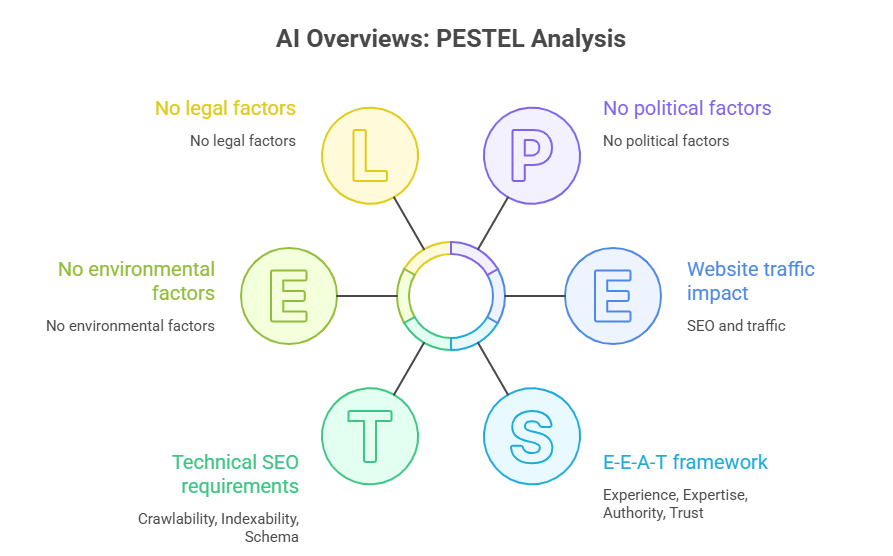
2. E-E-A-T: The Four Pillars of Trust
- Experience: Show first-hand knowledge with case studies, original data.
- Expertise: Display author credentials and deep subject knowledge.
- Authority: Earn backlinks and mentions from respected sites.
- Trust: Include author bios, contact info, and cite sources.
3. Technical SEO Requirements
- Ensure pages are crawlable and indexable (no 'nosnippet' tag).
- Implement FAQ, HowTo, and Article schema markup.
- Optimize for Core Web Vitals and mobile-first indexing.
- Build internal links to establish topical authority.
4. Freshness & Accuracy
- Regularly audit and update statistics and dated references.
- Add 'last reviewed' and 'last updated' dates to content.
- Remove or prominently update any outdated claims.
- Address corrections transparently to build trust.
Controversies, Limitations & Criticisms
AI Overviews have not been without controversy. Understanding their limitations is crucial for both users and content creators.
Accuracy & Hallucinations
Early versions produced famously incorrect answers (e.g., 'eat rocks'). While improved, hallucinations remain a risk. Google now includes disclaimers on YMYL topics.
Publisher Lawsuits
Major publishers have sued Google, arguing AIOs reproduce copyrighted content without fair compensation, threatening their business models.
Traffic Cannibalization
The core fear for creators is 'zero-click searches,' where Google provides the answer, and the user has no reason to visit the original website, hurting ad revenue and traffic.
AI Overviews vs. Google AI Mode
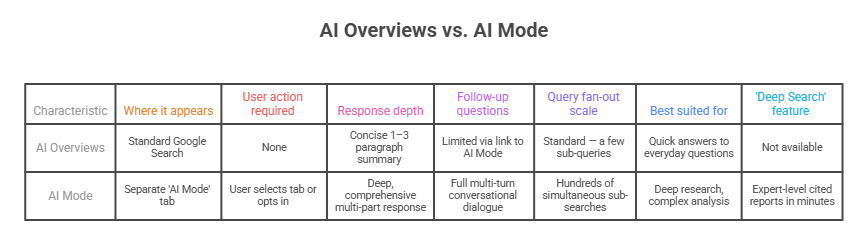
As of 2025, Google offers two distinct AI search experiences. Here is the clear distinction:
| Feature | AI Overviews | Google AI Mode |
|---|---|---|
| Where it Appears | Standard Google Search (default) | Separate 'AI Mode' tab in Search |
| User Action | Appears automatically | User must select AI Mode tab |
| Response Depth | Concise 1–3 paragraph summary | Deep, comprehensive multi-part response |
| Follow-up Questions | Limited, links to AI Mode | Full multi-turn conversational dialogue |
| Best Suited For | Quick answers to everyday questions | Deep research, complex analysis |
Think of AI Overviews as the 'quick answer' layer on top of normal search, and AI Mode as a separate, fully conversational research assistant for users who need to go much deeper on complex topics.
The Future of AI Overviews
Google's direction is clear: accelerate the integration of AI across all of Search. Several developments are already underway.
- Agentic AI Capabilities: Future AIOs may not just answer questions but take actions like comparing products or booking appointments.
- Multimodal Search: Integration with Google Lens and voice search will allow AIOs to respond to image and audio queries.
- Deeper Language Expansion: Continued expansion into non-English languages and under-served markets through 2026.
- Advertising Integration: New ad formats are being developed specifically for the AI Overview context.
'One of the most successful launches in Search in the past decade.'
The Bottom Line
Google AI Overviews represent a fundamental shift in how the world finds and consumes information online. They are not going away—they are expanding. For everyday users, they deliver faster, smarter answers to complex questions. For content creators, marketers, and businesses, they demand a new playbook: one focused on genuine expertise, clear structure, and building real trust with both readers and search engines. The organizations that adapt earliest will capture the most visibility in this new era of AI-powered search.
Frequently Asked Questions
AI Overviews are AI-generated answer summaries that appear at the very top of Google Search results above all organic links, ads, and featured snippets. Powered by Google's Gemini AI, they provide a concise, synthesised answer with links to the underlying sources so users can explore further.
They use three core technologies: the Gemini AI model, Retrieval-Augmented Generation (RAG)—which fetches live web content at the time of search rather than relying on training data—and Query Fan-Out, which breaks your question into multiple sub-queries and searches them simultaneously before merging the results into one answer.
No. They appear mainly for informational and complex queries like 'How does X work?' or 'X vs Y comparisons.' They do not appear for transactional searches ('Buy iPhone near me'), navigational searches ('Facebook login'), breaking news, or simple brand-name lookups.
It's mixed. The CTR for the #1 organic result drops by approximately 34.5% on informational queries when an AI Overview is present. However, pages outside the top 10 can still get cited, and users who do click from an AI Overview tend to have higher intent and convert better than average organic visitors.
Focus on strong E-E-A-T signals (Experience, Expertise, Authority, Trust), answer queries directly in your opening paragraph, use question-based headings, include a TL;DR summary, implement FAQ/HowTo schema markup, and keep content accurate and regularly updated. Technical basics like crawlability and Core Web Vitals also matter.
No. Hallucinations remain a risk, particularly on obscure or fast-changing topics. Shortly after the May 2024 launch, several widely-mocked errors surfaced. Google has since improved its safety filters, but you should always verify health, legal, and financial information by clicking through to the cited primary sources—never rely solely on the AI summary for important decisions.