Optimizing for the Top AI Answer Engines in 2026
TL;DR:
Your competitors are already showing up in AI answers. Are you? In 2026, with over 60% of searches influenced by AI, optimizing your content for answer engines isn't just an option—it's essential for visibility, trust, and traffic.
Start Your AEO Strategy Read the FAQThe Top AI Answer Engines to Target in 2026
If you want your content to be found, cited, and trusted, you need to know exactly which AI answer engines to optimize for and how each one works. Here are the most important platforms you need to focus on.
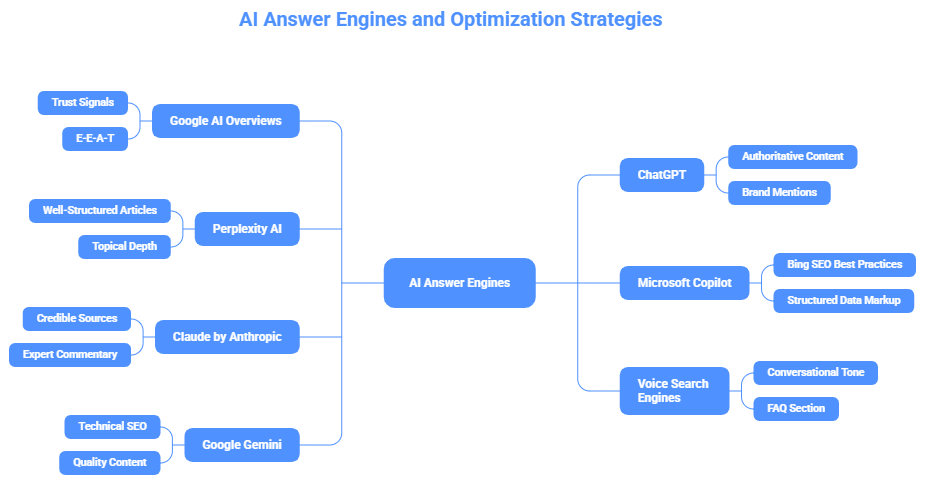
1. Google AI Overviews (formerly SGE)
Google AI Overviews have fundamentally changed what it means to rank number one. The top position is an AI-generated answer box. Getting cited here drives visibility that traditional rankings cannot match. Google selects content based on E-E-A-T, clear answers, logical heading structure, schema markup, and strong backlinks. If your content isn't written to this standard, it won't make the cut.
2. ChatGPT (OpenAI)
With over 200 million weekly active users, ChatGPT is a dominant AI platform. When browsing is enabled, it actively crawls and cites web content. To get cited, focus on brand mentions and authoritative content.
How to get cited by ChatGPT:
- Publish authoritative long-form content.
- Get mentioned on high-authority websites.
- Use plain, clear language that AI can process.
- Maintain a consistent brand presence online.
3. Perplexity AI
Perplexity AI is a real-time answer engine that cites sources for every answer, making it a great opportunity for direct traffic referrals. It rewards specificity and well-structured, up-to-date content.
What Perplexity prioritizes:
- Well-structured articles with clear headings.
- Frequently updated, accurate content.
- Content with strong topical depth.
- Fast-loading, mobile-friendly pages.
4. Microsoft Copilot (Bing AI)
Integrated into Bing, Windows, and Microsoft 365, Copilot is a high-value target for B2B content creators. Bing SEO best practices directly affect your Copilot visibility.
To rank in Microsoft Copilot:
- Submit your sitemap in Bing Webmaster Tools.
- Use structured data markup (FAQ, How-To).
- Optimize for Bing's ranking signals, including social signals.
- Target informational, question-based keywords.
5. Claude by Anthropic
Claude is increasingly used for research and professional decision-making. Optimizing for Claude means becoming a credible, widely referenced source. Content that gets cited, shared, and linked to is more likely to appear in its training data. Create primary reference content like whitepapers and original research.
6. Voice Search Engines (Siri, Alexa, Google Assistant)
Voice search strongly prefers content written in a natural, conversational tone. Answers are often pulled from featured snippets and structured FAQ pages.
Voice search optimization tips:
- Write in a question-and-answer format.
- Use short, direct sentences.
- Target long-tail, conversational keywords.
- Add a dedicated FAQ section to key pages.
7. Google Gemini
As Google's standalone AI assistant, Gemini powers AI Overviews and is integrated into Google products. Optimizing for Google overall through strong technical SEO and quality content will directly improve your visibility in Gemini's responses.
The Content Standards AI Engines Use
Every AI answer engine has its own ranking logic, but they all share one common filter: they only pull from content they can trust and understand quickly. Meeting that standard is not about gaming an algorithm. It is about producing content that is genuinely clear, accurate, and built for how people actually ask questions today.
How to Prioritize Your AEO Efforts
Not every platform deserves equal effort. Here is how to think about prioritization based on your audience.
For General Consumers
Focus on Google AI Overviews, voice search, and Perplexity first. These platforms dominate everyday user queries.
For B2B & Professionals
Prioritize Microsoft Copilot and ChatGPT. These are the tools most commonly used in work environments and research contexts.
For Long-Term Authority
Focus on all platforms simultaneously. Consistent visibility across multiple AI engines builds trust and increases the probability of being cited.
Frequently Asked Questions About AEO in 2026
The Future of Search is Answering
In 2026, AEO is not optional. It is a core part of any content strategy that wants to drive real, sustainable traffic. Your job is to make your content the most trustworthy, clearest, and best-structured answer to the questions your audience is already asking. Do that consistently, and AI engines will do the work of surfacing your brand for you.
Start with one platform, apply the best practices outlined here, measure your results, and expand from there. The future of search is answering, and the time to optimize for it is now.