Why Do Some Queries Return a Direct Answer Instead of a List of Links?
TL;DR:
'The search engine is not showing you a shortcut. It is making a precise judgment about what you actually need and deciding whether a list of links would waste your time.'
Two users open Google at the same moment. One types a question and gets an instant answer right on the results page. The other types a different question and gets ten blue links. Same search engine, same second, completely different experience. The reason is not random. Search engines follow a specific decision logic every time a query is submitted and understanding that logic is one of the most valuable things a content creator or marketer can know.
It Starts With Query Intent
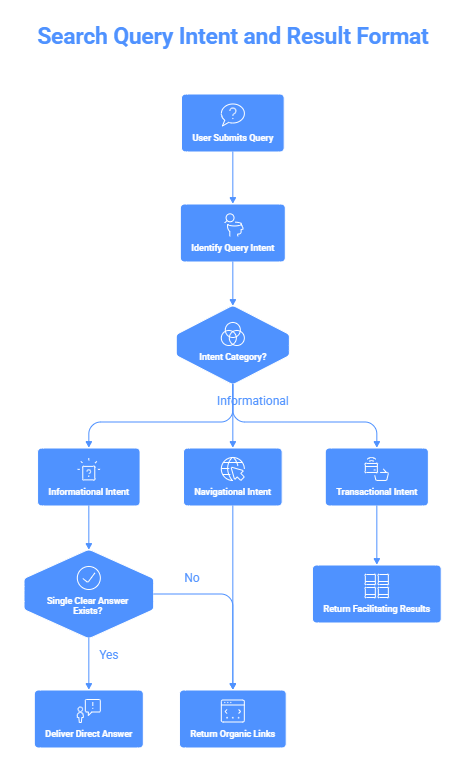
Every query a user submits carries an intent—a reason behind the words. Search engines have become highly accurate at identifying that intent, and the format of the results page is a direct reflection of what the search engine believes the user actually wants. Intent broadly falls into three categories, and the results format follows from whichever category the search engine assigns to the query.
Informational Intent
The user wants to know something. They are seeking a fact, an explanation, a definition, a process, or an answer to a question. This is the intent category that most frequently triggers a direct answer. When the search engine classifies a query as informational and determines that a single, clear answer exists, it delivers that answer directly rather than sending the user off to find it themselves. Queries beginning with 'what', 'why', 'how', 'who', 'when', and 'where' are the clearest signals of informational intent.
Navigational Intent
The user wants to reach a specific destination—a website, a login page, a brand's homepage. There is no answer to deliver here. The user is not asking for information; they are asking to be directed. Search engines return organic links for navigational queries because a direct answer would not serve the intent. The user needs a door, not an explanation.
Transactional Intent
The user wants to take an action—buy something, sign up, download, book. The search engine returns results that facilitate that action: product listings, comparison pages, landing pages. A direct answer would interrupt the journey rather than support it. These queries almost never trigger direct answers because the intent is not to receive information but to complete a task.
The Answerability Test: Not Every Informational Query Gets a Direct Answer
Intent classification is the first filter, but it is not the only one. Even among informational queries, many return a list of links rather than a direct answer. The reason is what can be called the 'answerability test'—the search engine's evaluation of whether a clear, reliable, complete answer actually exists and can be delivered confidently.
The Answer Must Be Definable
A query returns a direct answer when the search engine can identify a response that is correct, complete, and unlikely to be disputed. 'What is the boiling point of water?' is answerable. 'What is the best approach to leadership?' is not. This is why opinion-based, context-dependent, or highly contested queries rarely trigger direct answers.
The Answer Must Be Deliverable in a Short Form
Even when an answer exists, it must be expressible in a format that fits a results page. If an answer requires a 3,000-word report, links to longer resources are the more useful response. The search engine evaluates whether the answer can be meaningfully delivered in a paragraph, a short list, a number, or a sentence.
The Answer Must Come From a Trustworthy Source
Search engines only deliver direct answers from sources they have already evaluated as credible and accurate. If no trusted source in the index clearly answers a query, the search engine will not fabricate an answer; it will return links and let the user evaluate the available information themselves.
The Specific Query Signals That Trigger Direct Answers
Beyond intent classification, certain structural and linguistic features of a query make a direct answer significantly more likely. These are the signals search engines use to confirm that the user wants an answer, not a list.
Question Phrasing
Queries phrased as explicit questions are the strongest trigger. 'What causes inflation' signals clear informational intent with a definable answer. A keyword-style query like 'content marketing' is more ambiguous.
Specificity
Specific queries are far more likely to return direct answers than broad ones. 'What is the capital of Japan?' returns a direct answer. 'What is Japan?' returns links. Specificity signals a clear, bounded information need.
Factual Nature of the Query
Queries that ask for facts—dates, measurements, definitions—are strong direct answer candidates because facts have objectively correct answers that do not require the user to evaluate competing perspectives.
Conversational and Natural Language Phrasing
As voice search has grown, search engines have become better at recognising natural language queries. These conversational queries are handled almost exclusively by direct answer formats, because a voice interface cannot return a list of ten links.
When a List of Links Is the Right Answer
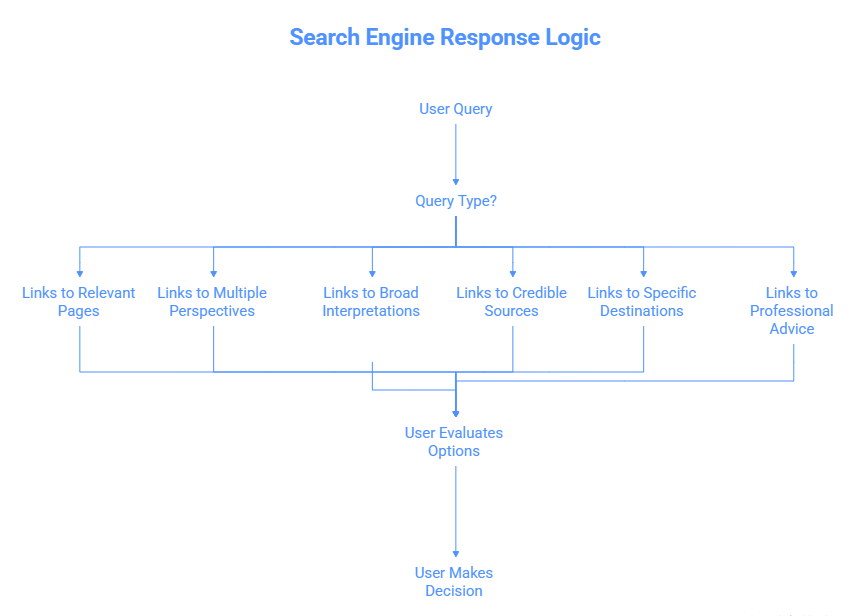
Understanding when links are the appropriate response is just as important. Search engines return links not direct answers in specific, predictable situations:
- When the query is commercial or transactional.
- When the answer is genuinely contested or has multiple valid perspectives.
- When the query is too broad to have a single answer.
- When no trusted source clearly states the answer.
- When the query is navigational.
- When the topic involves sensitive or high-stakes decisions (medical, legal, financial).
What This Means for Your AEO Strategy
Answer Engine Optimisation (AEO) is built on the same logic the search engine uses to decide between a direct answer and a list of links. Applying that logic to your content planning produces a clear set of priorities:
- Target queries that are clearly informational and phrased as questions.
- Write answers that are specific and bounded. Vague responses fail the answerability test.
- Make your answers extractable. A short, clearly stated response immediately beneath a question-phrased heading is ideal.
- Build source credibility. Authority, accuracy, and consistency are prerequisites.
- Avoid targeting contested or opinion-based queries for direct answer positions.
If you want your content to earn a direct answer position, your job is to make the search engine's decision easy. You need to produce content that passes every stage of the evaluation.
Frequently Asked Questions
Final Thoughts
The decision between a direct answer and a list of links is not made by chance. It follows a logic built on intent classification, answerability, source trust, and query structure. For content creators, this logic is the foundation of an effective AEO strategy. The search engine is always asking: does this query have a clear, trustworthy, deliverable answer? Build content that helps it answer 'yes', and the decision to surface your content becomes an easy one.