What Is AEO and GEO in Digital Marketing?
Digital marketing in 2026 is no longer a single-channel discipline. Understand the two most significant shifts reshaping strategy: Answer Engine Optimization (AEO) and Generative Engine Optimization (GEO), and how they are essential for visibility in the AI-powered landscape.
Analyze Your AEO/GEO ScoreBook a DemoThe New Digital Marketing Landscape
For most of the past two decades, digital marketing visibility came down to three core disciplines: search engine optimization (SEO), pay-per-click (PPC) advertising, and social media marketing. These pillars worked because they mapped directly to where users spent their time. The rise of generative AI has added an entirely new layer to that map. Users now ask questions to AI platforms and receive composed answers without needing to click through to a website. The journey from question to answer no longer runs through a list of links—it runs through an AI model that reads, evaluates, and synthesises content on the user's behalf. AEO and GEO are the two disciplines that digital marketers use to maintain and grow visibility within this new environment.
AEO in Digital Marketing: What Role Does It Play?
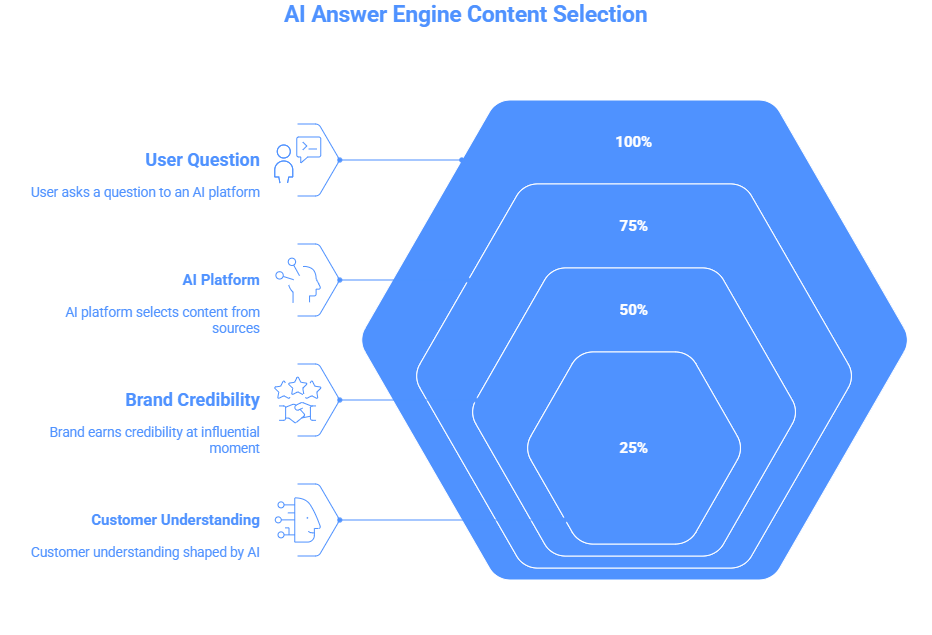
In the context of digital marketing, Answer Engine Optimization (AEO) is the discipline that ensures your brand's informational content is selected, cited, and surfaced by AI answer engines when users ask questions relevant to your industry. It operates at the intersection of content marketing, technical SEO, and brand authority building. When a potential customer asks an AI platform a question that your product or service answers, the AI's response will shape that customer's understanding before they ever visit your website. If your content is the source the AI draws from, your brand earns credibility and awareness at the most influential moment in the customer's decision journey. This is why AEO has become a core pillar of digital marketing strategy. It is not about gaming an algorithm; it is about being the most credible, clearest, and most trustworthy voice in your space.
How AEO Fits Into the Digital Marketing Funnel
AEO is most powerful at the top and middle of the digital marketing funnel—the awareness and consideration stages. When a user asks an AI engine a question about a problem your business solves, appearing as the cited source plants your brand in their awareness before they have actively searched for you. Over time, consistent AEO visibility drives branded search volume, increases direct traffic, and shortens the sales cycle by building pre-visit trust.
AEO as a Brand Authority Tool
Beyond traffic and citations, AEO functions as one of the most effective brand authority tools available. When an AI platform consistently cites your content as a source for authoritative answers, it signals to users that your brand is the credible expert in that space. This perceived authority transfers to every other digital marketing touchpoint the user encounters, from your website to your social media presence.
What Is GEO and How Is It Different From AEO?
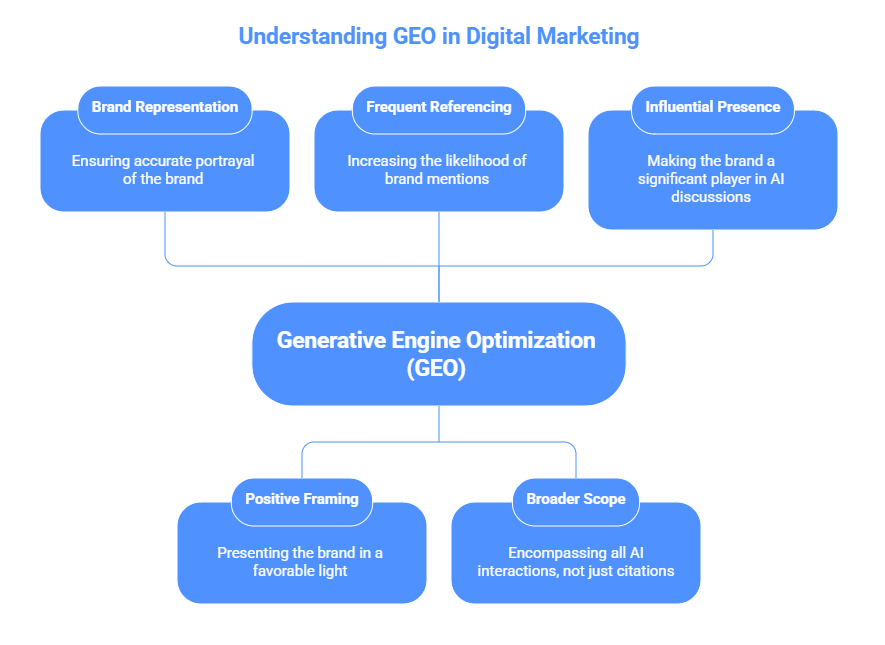
Generative Engine Optimization (GEO) is the practice of optimising your brand's presence and content so that it is accurately represented, positively framed, and frequently referenced within the outputs of generative AI models. While AEO focuses specifically on getting your content cited as a source in AI-generated answers, GEO takes a broader view. It is concerned with how your brand appears across all generative AI interactions, not just citation-based answers.
Think of the difference this way: AEO asks, 'Is my content being selected as a source for a relevant question?' GEO asks, 'When an AI model discusses my industry or competitors, does my brand appear in an accurate, favourable, and influential way?' GEO encompasses a wider set of concerns because generative AI outputs are not limited to direct Q&A formats. A user might ask an AI to recommend software, compare providers, or summarise leading brands. Whether your brand appears in those outputs is a GEO question.
The Core Goals of GEO in Digital Marketing
GEO is built around four interconnected goals that determine how a brand is represented in the generative AI ecosystem:
- Brand Inclusion: Ensuring your brand is mentioned and considered by AI models.
- Accurate Representation: Ensuring AI models have correct information about your brand.
- Positive Framing: Influencing the sentiment and context in which your brand is described.
- Competitive Visibility: Maintaining presence where competitors are discussed or recommended.
Achieving these goals requires a different set of strategies from AEO. While AEO is heavily content-focused, GEO draws more from brand management, digital PR, and reputation building. A brand that appears frequently in positive, authoritative contexts across a wide range of credible sources builds a strong generative AI presence over time. GEO is the discipline that actively manages this process rather than leaving it to chance.
How AEO and GEO Work Together
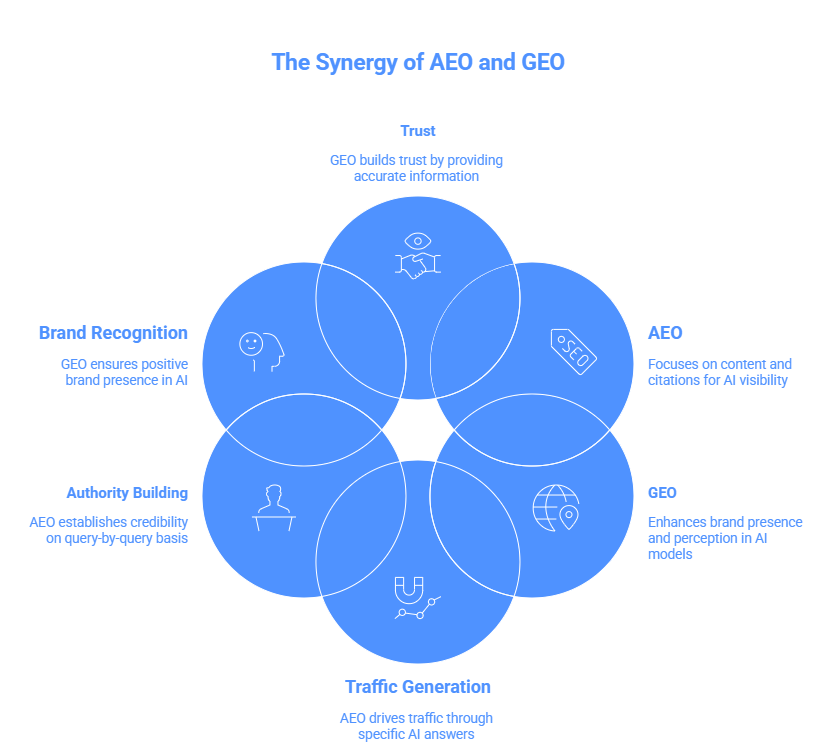
AEO and GEO are complementary disciplines, not competing ones. The strongest digital marketing strategies treat them as two sides of the same AI visibility coin. AEO handles the content and citation layer, while GEO handles the brand presence and perception layer. A business that invests heavily in AEO earns citations, but without GEO, it may be absent from broader AI recommendations. Conversely, focusing only on GEO may build brand presence but miss specific citation opportunities that drive traffic. The two disciplines need each other to deliver their full value.
Key Differences: AEO vs. GEO
Answer Engine Optimization (AEO)
A primarily content and technical discipline.
- Focus: Content structure, schema, question-based writing, technical accessibility.
- Goal: Get a specific page selected as a source for a specific AI answer.
- Measurement: Citation frequency, AI referral traffic, AI Overview appearances, featured snippets.
- Team: Content Marketing, SEO.
Generative Engine Optimization (GEO)
A primarily brand and communications discipline.
- Focus: Brand mentions, digital PR, reputation management, consistent brand narrative.
- Goal: Ensure the brand is present, accurate, and positively framed in all AI outputs.
- Measurement: Brand mention frequency, sentiment analysis, share of voice in AI discussions.
- Team: Brand Management, Digital PR, Communications.
How to Build an Integrated AEO and GEO Strategy
Building an integrated strategy requires a clear framework that connects both disciplines to overarching business goals.
1. Start With a Visibility Audit Across AI Platforms
Run your top industry queries and broader brand-related questions across Google AI Overviews, Perplexity, ChatGPT, and Microsoft Copilot. This dual audit will reveal your current AEO citation gaps and GEO presence gaps, giving you a prioritised list of where to focus first.
2. Build Your AEO Content Layer First
For most businesses, the fastest results come from AEO. Start by optimising existing content with an answer-first structure, question-based headings, and schema markup. Create or improve content to compete for queries where competitors are being cited.
3. Build Your GEO Brand Presence in Parallel
Alongside AEO work, invest in activities that feed AI models with accurate and positive information. This includes earning media coverage, publishing original research, and ensuring brand information is consistent across the web.
4. Measure Both Disciplines With Separate but Connected Metrics
Track AEO with citation frequency and referral traffic. Track GEO with brand mention frequency and sentiment analysis. Review both sets of metrics monthly to see how a growing GEO presence accelerates AEO citation rates.
Frequently Asked Questions
Final Thoughts: Winning in the AI Era
AEO and GEO represent the two essential disciplines of digital marketing in the AI era. AEO earns your content a seat at the table for specific user queries, while GEO ensures your brand is present, accurate, and positively represented in broader AI conversations. The businesses that understand, invest in, and measure both disciplines are building a genuinely future-proof digital marketing presence. Start where the gaps are greatest, build the two disciplines in parallel, and treat every piece of content as both an AEO asset and a GEO signal. That mindset is what separates the brands winning in AI search today from the ones still playing catch-up.